Key Takeaways
| Takeaway | Why It Matters |
|---|---|
| Purina Pro Plan sensitive skin and stomach cat food contains prebiotic only | No live probiotics — you may need to add FortiFlora separately |
| Chicken meal is present (4th ingredient) | Despite “lamb & rice” name, this food is NOT for chicken-allergic cats |
| Probiotics reduce transition diarrhea by up to 40% | Worth adding during the 7-14 day switch |
| Prebiotics feed existing bacteria | Helpful but less effective than live probiotics |
| Not all probiotic strains work for cats | Choose Enterococcus faecium (FortiFlora) for proven survivability |
| Best for mild sensitivity | Not appropriate for severe IBD or confirmed food allergies |
Disclaimer: Always consult your veterinarian for persistent digestive problems. This information is vet-reviewed but not a substitute for professional medical advice. For a complete list of vet-recommended options, see our guide on the best cat food for sensitive stomach .
Opening: The Probiotic Question
You’ve seen “probiotics” and “prebiotics” on cat food bags. Your veterinarian mentions gut health. Your fellow cat owners swear by FortiFlora. But do these supplements actually help a cat with a sensitive stomach? Or is it just another marketing trend?
And what about Purina Pro Plan sensitive skin and stomach cat food — a popular, mid-priced option that claims to support digestive health? Does it contain probiotics? Should you add your own?
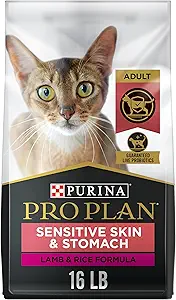
I’m Dr. Allona Jackson, DVM, and together with Ahashanul Hoque at AvailPet, we’ll separate evidence from hype. Using Purina Pro Plan sensitive skin and stomach cat food (Lamb & Rice) as our example — check current price on Amazon here — we’ll explain exactly how probiotics work, when they help, and when they’re useless.
Before we dive in: If you haven’t already, read our guide on how long sensitive stomach cat food takes to work — it covers the 12-week timeline that applies to Purina Pro Plan as well.
Let’s start with an honest look at the ingredient label, because what’s not advertised matters.
First, Let’s Be Honest About the Ingredients
Purina Pro Plan sensitive skin and stomach cat food ingredient list (Lamb & Rice formula):
| Ingredient | Verdict | Why It Matters |
|---|---|---|
| Lamb | ✅ Good | Novel protein for many cats |
| Rice | ✅ Acceptable | Easily digestible carbohydrate |
| Corn Protein Meal | ❌ Caution | Plant protein; some cats react |
| Chicken Meal | ⚠️ PROBLEM | Contains chicken — common allergen |
| Soybean Meal | ❌ Caution | Common feline irritant |
| Beef Fat | ⚠️ Acceptable | Another animal protein source |
| Oat Meal | ✅ Good | Easily digestible, gentle on stomach |
| Barley | ✅ Acceptable | Digestible grain |
| Dried Chicory Root | ✅ Good | Prebiotic (FOS) — feeds good bacteria |
| Live Probiotics | ❌ NOT PRESENT | Prebiotic only, no live bacteria |
The honest truth from Dr. Jackson:
“This food has a significant problem for cats with true food allergies: chicken meal. If you suspect chicken allergy, Purina Pro Plan sensitive skin and stomach cat food is not safe despite being labeled ‘lamb and rice.’ The chicken meal is the fourth ingredient. For cats with mild sensitivity who tolerate chicken and grains, this formula’s prebiotic and oatmeal may still help. But know exactly what you’re buying — and what you’re not buying (live probiotics).”
Who this food IS for: Cats with mild digestive sensitivity who tolerate chicken and grains.
Who this food IS NOT for: Cats with confirmed chicken allergy or severe food allergies.
If your cat needs a chicken-free option: See our deep dive on what is a limited ingredient diet for cats , where we review Blue Buffalo Basics — zero chicken, live probiotics included.
Probiotics vs. Prebiotics — What’s the Difference?
This is the most misunderstood concept in feline gut health. Let me clarify.
| Type | Definition | Source | Example |
|---|---|---|---|
| Probiotics | Live beneficial bacteria that colonize the gut | Fermentation products, supplements | Enterococcus faecium, Lactobacillus |
| Prebiotics | Food (fiber) that feeds existing beneficial bacteria | Plant fibers | FOS (fructooligosaccharides), inulin, chicory root |
| Synbiotics | Probiotics + prebiotics together | Combined products | Some premium cat foods |
| Postbiotics | Beneficial compounds bacteria produce | Fermentation byproducts | Short-chain fatty acids (butyrate) |
Simple analogy — a garden:
- Probiotics = planting new seeds (live bacteria)
- Prebiotics = fertilizer for existing plants (feeds bacteria already there)
- Synbiotics = seeds + fertilizer together
- Postbiotics = the vegetables that grow (health benefits)
Where Purina Pro Plan sensitive skin and stomach cat food fits:
- Contains prebiotic (chicory root) — the fertilizer
- Contains NO live probiotics — no new seeds
- You must add a separate probiotic (like FortiFlora) to get live bacteria
Where Blue Buffalo Basics fits:
- Contains both prebiotic AND live probiotics (synbiotic) — read our full Blue Buffalo Basics review here .
Where Hill’s Science Diet fits:
- Contains prebiotic only (similar to Purina) — see our Hill’s Science Diet timeline guide .
Does Purina Pro Plan Sensitive Skin and Stomach Cat Food Have Probiotics?
No. This is critical to understand.
Purina Pro Plan sensitive skin and stomach cat food contains prebiotic fiber (dried chicory root) but does not contain live probiotics.
The product description says: “natural prebiotic fiber for digestive health” — note “prebiotic,” not “probiotic.” These are not the same thing.
| What It Has | What It Does NOT Have |
|---|---|
| Prebiotic (chicory root) | Live bacteria (probiotics) |
| Easily digestible oatmeal | Fermentation products |
| Omega fatty acids | Enterococcus or Lactobacillus strains |
If you stick with Purina Pro Plan: Add Purina Pro Plan FortiFlora probiotic separately (same brand, clinically proven compatibility).
The Clinical Mechanism: How Probiotics Help Sensitive Stomachs
By Dr. Allona Jackson, DVM
“The feline gut contains trillions of bacteria — collectively called the microbiome. In a healthy cat, beneficial bacteria outnumber harmful ones. In a cat with a sensitive stomach, food allergy, or after antibiotic treatment, this balance is disrupted — a condition called dysbiosis. Probiotics introduce specific beneficial strains that perform four critical functions: (1) they compete with harmful bacteria for resources and attachment sites, (2) they produce short-chain fatty acids (like butyrate) that nourish gut lining cells, (3) they strengthen tight junction proteins that prevent ‘leaky gut,’ and (4) they modulate local immune responses in the gut-associated lymphoid tissue (GALT). Not all strains survive feline stomach acid. Enterococcus faecium (found in FortiFlora and Blue Buffalo Basics) has high survivability. Lactobacillus strains vary significantly. This is why ‘probiotics’ on a label doesn’t guarantee effectiveness — strain, viability, and delivery method matter enormously.”
For a deeper understanding of gut healing timelines, see our clinical explanation of the 8-12 week window in the Hill’s Science Diet article.
Do Probiotics Actually Work? Reviewing the Evidence
| Study Finding | Clinical Implication for Your Cat |
|---|---|
| Probiotics reduce antibiotic-associated diarrhea by 40% | Give probiotics whenever your cat is on medication |
| Enterococcus faecium survives feline stomach acid | Choose this strain over human strains |
| Probiotics shorten food transition diarrhea by 3-5 days | Worth adding during the 7-14 day switch to new food |
| Probiotics alone don’t fix food allergies | Must remove trigger protein (chicken, beef, fish) |
| Prebiotics alone have weaker evidence than probiotics | Better than nothing, but live probiotics are more effective |
| Synbiotics (probiotics + prebiotics) show best results | Blue Buffalo Basics has this; Purina requires add-on |
Bottom line: Probiotics help, but they are not a substitute for removing trigger ingredients. If a cat is eating chicken and is allergic to chicken, no amount of probiotics will stop the immune reaction. Fix the protein first, then add probiotics.
Not sure if your cat has a food allergy vs. sensitivity? Our cluster guide to sensitive stomach cat food explains the difference and when to choose which food.
When to Add a Separate Probiotic to Purina Pro Plan
Since Purina Pro Plan sensitive skin and stomach cat food contains prebiotic only, adding a dedicated probiotic provides significant additional benefit.
Recommended feline probiotics (proven effective):
| Product | Strain | Form | Best For | Link |
|---|---|---|---|---|
| Purina Pro Plan FortiFlora | Enterococcus faecium | Powder sachet | General digestive health, compatibility with Purina food | View on Amazon |
| Nutramax Proviable-DC | Multiple strains (7) | Capsule | Severe dysbiosis, chronic diarrhea | Check price |
| VetriScience Probiotic Everyday | Multiple strains | Chewable tablet | Picky cats who reject powder | Check price |
Dr. Jackson’s clinical protocol:
“If you’re feeding Purina Pro Plan sensitive skin and stomach cat food, add FortiFlora (same brand) for the first 4-6 weeks of transition. After symptoms resolve — meaning normal stool, no vomiting for 2+ weeks — try stopping the probiotic. Many cats maintain improvement on the prebiotic alone. If symptoms return within 2 weeks of stopping FortiFlora, continue probiotic long-term. Some cats need ongoing probiotic support; others don’t. You won’t know until you try.”
Step-by-Step: Transitioning to Purina Pro Plan With Probiotic Support
Option A: Purina Pro Plan Alone (Prebiotic Only)
| Days | Old Food | Purina Pro Plan | Expected Symptoms |
|---|---|---|---|
| 1-3 | 75% | 25% | Minimal — some cats refuse new food |
| 4-6 | 50% | 50% | Possible soft stool |
| 7-9 | 25% | 75% | Some gas, mild loose stool |
| 10-14 | 0% | 100% | Should be improving |
Option B: Purina Pro Plan + FortiFlora Probiotic (Recommended)
| Phase | Duration | Action | Expected Outcome |
|---|---|---|---|
| Transition | Days 1-14 | Sprinkle 1 packet FortiFlora on food daily | Reduced diarrhea by 40% |
| Stabilization | Days 15-42 | Continue FortiFlora daily | Stool firms up by week 4-6 |
| Trial off probiotic | Day 43+ | Stop FortiFlora, monitor for 2 weeks | Some cats maintain; others need ongoing |
| Long-term | If symptoms return | Restart FortiFlora indefinitely | Safe for lifelong use |
Option C: Adding Wet Food for Hydration (Best Results)
Purina Pro Plan sensitive skin and stomach wet food (Lamb formula) is often easier to digest than dry kibble. For a complete analysis of moisture content and digestibility, see our pillar guide: Wet vs. Dry Cat Food: A Vet-Reviewed Guide .
- Mix 1 tablespoon wet food with dry kibble
- Gradually increase wet food ratio over 2 weeks
- Wet food adds critical moisture (78% vs. 10% in dry)
Bundle all three: Purina Pro Plan dry + wet + FortiFlora — see the starter kit below .
Week-by-Week Symptom Tracker for Purina Pro Plan Users
Copy this table into a notebook. Track daily for 8 weeks.
| Week | Vomiting (0-5)* | Stool Score (1-5)** | Probiotic Given? | Appetite (Good/Poor) | Energy (Normal/Low) |
|---|---|---|---|---|---|
| 1 | |||||
| 2 | |||||
| 3 | |||||
| 4 | |||||
| 5 | |||||
| 6 | |||||
| 7 | |||||
| 8 |
Vomiting scale (0-5):
- 0 = No vomiting
- 1 = Once in 7 days
- 2 = 2-3 times in 7 days
- 3 = Weekly
- 4 = Several times weekly
- 5 = Daily (stop food, call vet)
Stool score (1-5):
- 1 = Hard, dry pellets (constipated — add wet food or pumpkin)
- 2 = Firm, segmented (ideal)
- 3 = Log-shaped, moist (good)
- 4 = Soft, unformed (mild diarrhea — wait, add probiotic)
- 5 = Watery (severe diarrhea — stop new food, call vet)
Comparison: Probiotic Content Across Sensitive Stomach Foods
| Product | Prebiotic | Live Probiotics | Probiotic Strains | Survivability | Best For |
|---|---|---|---|---|---|
| Purina Pro Plan | ✅ (chicory root) | ❌ No | N/A | N/A | Mild sensitivity, add your own probiotic |
| Blue Buffalo Basics | ✅ (chicory root) | ✅ Yes | 5 strains (Enterococcus, Lactobacillus, etc.) | High | One-and-done solution — read our review |
| Hill’s Science Diet | ✅ (FOS) | ❌ No | N/A | N/A | Mild sensitivity, prebiotic only — see timeline |
| Royal Canin Selected Protein | ❌ No | ❌ No | N/A | N/A | Prescription needed, no gut support |
| Hill’s Prescription Diet z/d | ❌ No | ❌ No | N/A | N/A | Severe allergies, hydrolyzed only |
Verdict: Blue Buffalo Basics has the strongest probiotic content (synbiotic). Purina Pro Plan requires an add-on probiotic for live bacteria. Hill’s has none.
For prescription options when OTC fails, stay tuned for our upcoming guides on Royal Canin Selected Protein and Hill’s z/d.
FAQ: Purina Pro Plan Sensitive Skin and Stomach Cat Food (9 Questions)
1. Does Purina Pro Plan sensitive skin and stomach cat food have live probiotics?
No. It contains prebiotic (dried chicory root) only. No live bacteria. You must add a separate probiotic like FortiFlora to get live probiotics.
2. Should I add a probiotic to Purina Pro Plan?
Yes — especially during the first 4-6 weeks of transition. Add Purina Pro Plan FortiFlora (same brand, proven compatibility). View FortiFlora on Amazon here .
3. Can I give my cat human probiotics?
No. Human strains (Lactobacillus acidophilus, Bifidobacterium) have low survivability in feline stomach acid. Use feline-specific strains: Enterococcus faecium (FortiFlora) or veterinary-grade multi-strain products.
4. How long until probiotics work?
2-4 weeks for noticeable improvement in stool quality. Some cats show improvement in 7-10 days. Full microbiome stabilization takes 4-6 weeks. For the complete 12-week healing timeline, see our detailed guide here .
5. Can probiotics make my cat worse?
Rarely. Some cats experience transient gas or bloating in the first 3-5 days. This resolves. If vomiting or diarrhea worsens, stop the probiotic and consult your veterinarian.
6. Does Purina Pro Plan sensitive skin and stomach cat food contain chicken?
Yes — despite being labeled “Lamb & Rice,” chicken meal is the 4th ingredient. This food is NOT for cats with confirmed chicken allergy. For chicken-free options, see our limited ingredient diet guide .
7. Is this food grain-free?
No. Contains rice, barley, and oatmeal. If your cat needs grain-free, choose Blue Buffalo Basics instead.
8. How does Purina Pro Plan compare to Blue Buffalo Basics?
| Feature | Purina Pro Plan | Blue Buffalo Basics |
|---|---|---|
| Primary protein | Lamb + chicken meal | Duck only (novel) |
| Grains | Yes (rice, barley, oat) | No (grain-free) |
| Live probiotics | No (prebiotic only) | Yes (5 strains) |
| Chicken-free? | No (contains chicken meal) | Yes |
| Best for | Mild sensitivity, chicken-tolerant | Suspected allergies, elimination diet |
For a complete breakdown of Blue Buffalo Basics, read What Is a Limited Ingredient Diet for Cats? .
9. Can I use Purina Pro Plan sensitive skin and stomach cat food for my cat with IBD?
Only for mild cases. Severe IBD (inflammatory bowel disease) or confirmed food allergies require prescription hydrolyzed diets (Hill’s z/d or Royal Canin Selected Protein). Consult your veterinarian before using OTC food for diagnosed IBD.
Where To Buy
When to Quit Purina Pro Plan (And What to Try Next)
Quit signs (after 6 weeks on full diet, not during transition):
| Sign | Action |
|---|---|
| Vomiting frequency unchanged or worse | Stop. Try Blue Buffalo Basics (chicken-free) — read our review |
| Diarrhea continues (score 4-5 for 2+ weeks) | Stop. Add probiotic first, then consider LID |
| Cat refuses to eat it consistently | Stop. Try wet version or different protein |
| New symptoms appear (itchy skin, overgrooming, ear infections) | Likely chicken allergy. Move to chicken-free LID |
| No improvement after 8 weeks on food + probiotic | Move to prescription novel protein or hydrolyzed diet |
AvailPet’s escalation path (from this article series):
| If This Happens | Try Next | Why | Link |
|---|---|---|---|
| Chicken allergy suspected | Blue Buffalo Basics Limited Ingredient Diet | Zero chicken, zero grains, live probiotics | Read full guide |
| No improvement after 8 weeks on Purina + probiotic | Hill’s Science Diet Sensitive Stomach | Different protein (chicken) but similar profile | Read timeline guide |
| Moderate-severe, chronic symptoms | Royal Canin Selected Protein (prescription) | Novel protein (duck/rabbit/venison) | Coming soon |
| Vet-confirmed true food allergy | Hill’s Prescription Diet z/d (prescription) | Hydrolyzed protein — no immune recognition | Coming soon |
For a complete list of all recommended options, return to our best cat food for sensitive stomach cluster guide .
Final Verdict: Purina Pro Plan Sensitive Skin and Stomach Cat Food
Best for:
- Mild, intermittent digestive upset (occasional soft stool, some gas)
- Cats who tolerate chicken and grains (despite lamb label, chicken meal present)
- Owners wanting mid-priced option between budget and premium LID
- Cats with concurrent skin/coat issues (omega fatty acids from lamb + beef fat)
- Multi-cat households where all cats tolerate chicken and grains
Not ideal for:
- Confirmed chicken allergy (contains chicken meal as 4th ingredient)
- Grain-sensitive cats (contains rice, barley, oatmeal)
- Severe or chronic digestive disease (IBD, chronic diarrhea)
- Cats who failed Hill’s Science Diet (similar grain/chicken profile) — see why Hill’s may have failed
- Owners who want a single-bag solution (needs add-on probiotic)
Bottom line from Dr. Jackson:
“Purina Pro Plan sensitive skin and stomach cat food is a reasonable mid-tier option for cats with mild sensitivity who tolerate chicken and grains. The prebiotic (chicory root) is a nice addition, but the absence of live probiotics means you’re missing half the gut health benefit. If you choose this food, add FortiFlora for the first 6 weeks — the combination of prebiotic + probiotic (synbiotic) gives you the best results. And be honest about the chicken meal: this is not a ‘lamb only’ food. Read the label. For cats with suspected chicken allergy, Blue Buffalo Basics is the better choice — read our full comparison here . For mild cases where budget matters, Purina Pro Plan plus FortiFlora works well.”
Before making your final decision, review our comprehensive best cat food for sensitive stomach guide to see how Purina Pro Plan compares to all five top picks.
🐾 Probiotic Starter Kit (Purina Pro Plan + FortiFlora Bundle)
*Vet-designed combination for the first 8 weeks — prebiotic + probiotic + hydration*
| Item | Purpose | Price |
|---|---|---|
| Purina Pro Plan Sensitive Skin & Stomach Lamb & Rice (16 lb) | Primary food — prebiotic fiber for digestive health | $56.48 |
| Purina Pro Plan FortiFlora Probiotic (30-pack) | Live probiotic — add to food daily for 4-6 weeks | $34.99 |
| Purina Pro Plan Sensitive Wet (Lamb, 12-pack) | Hydration + easier digestion — mix with dry | $32.99 |
Bundle total if purchased separately: $124.46
Buy the complete bundle on Amazon:
- Purina Pro Plan Sensitive Skin & Stomach Dry Food
- Purina Pro Plan FortiFlora Probiotic (search within same store)
- Purina Pro Plan Sensitive Wet Food (12-pack)
Why this bundle? Dry food provides prebiotic fiber (chicory root). FortiFlora adds live probiotics that the dry food lacks. Wet food adds critical hydration (78% moisture) and is often easier to digest during transition. This combination gives you synbiotic support — prebiotic + probiotic together — which clinical evidence shows is more effective than either alone. For more on why wet food helps sensitive stomachs, see our wet vs dry cat food pillar guide .
Individual products also sold separately. No prescription required for any item in this bundle.
Sources
- Cornell Feline Health Center – Feline Inflammatory Bowel Disease
- WSAVA Global Nutrition Guidelines – Adverse Food Reactions
- Journal of Veterinary Internal Medicine – Probiotic Use in Feline Gastroenteropathy (2024)
- Purina Pro Plan Sensitive Skin & Stomach Product Information
- Purina Pro Plan FortiFlora Clinical Research Summary
- AvailPet.com – Best Cat Food for Sensitive Stomach
- AvailPet.com – Wet vs Dry Cat Food Guide
- AvailPet.com – How Long for Sensitive Stomach Food to Work
Disclaimer: Always consult your veterinarian before adding probiotics or changing your cat’s diet, as vomiting and diarrhea can indicate serious medical conditions including pancreatitis, IBD, or intestinal lymphoma. These product suggestions are not a substitute for professional diagnosis. We may earn from qualifying purchases on Amazon.
Have you tried Purina Pro Plan sensitive skin and stomach cat food for your cat? Did you add a probiotic? Share your experience in the comments below — your story helps other cat owners make informed decisions. And don’t forget to check out our complete sensitive stomach cat food guide for all five vet-recommended options.