Reviewed by Ahashanul Hoque, AvailPet.com
Clinically reviewed for transition protocols, microbiome turnover rates, and expected symptomatic improvement windows.
Key Takeaways: Hill’s Science Diet Sensitive Stomach Cat Food
| Takeaway | Why It Matters |
|---|---|
| 8-12 weeks is the real timeline | Gut healing takes time — microbiome turnover alone requires 4-6 weeks |
| Vomiting improves before stool | Upper GI heals faster than lower GI. Expect vomiting to stop first (2-4 weeks), then stool to firm up (4-6 weeks) |
| Track symptoms daily | A simple stool score (1-5) helps you know when to wait vs. when to switch foods |
| Don’t quit at week 3 | Most owners give up right before improvement would have occurred |
| Hill’s Science Diet works for mild cases | But check ingredients — corn gluten meal may be a trigger for some cats |
Disclaimer: Always consult your veterinarian for persistent digestive problems. This information is vet-reviewed but not a substitute for professional medical advice.
Opening: The Question Every Cat Owner Asks
You switched your cat to a sensitive stomach diet. Maybe you chose Hill’s Science Diet Sensitive Stomach & Skin — the #1 vet-recommended brand. Now you’re watching every litter box visit, monitoring every meal, and holding your breath after each feeding.
The question that keeps you up at night: When will this actually work?
I’m Dr. Allona Jackson, DVM, and together with Ahashanul Hoque at AvailPet, we’ll give you a realistic, week-by-week timeline. We’ll use Hill’s Science Diet Sensitive Stomach as our real-world example — including an honest look at its ingredients (yes, even the controversial ones).
Let’s start with something most articles won’t tell you.
First, Let’s Check the Ingredients (Even on “Vet-Recommended” Brands)
Hill’s Science Diet Sensitive Stomach & Skin (Chicken & Rice) lists:
| Ingredient | Verdict | Why |
|---|---|---|
| Chicken | ✅ Good | High-quality animal protein |
| Brewers Rice | ⚠️ Acceptable | Digestible carbohydrate source |
| Corn Gluten Meal | ❌ Caution | Plant protein concentrate; some sensitive cats react |
| Whole Grain Corn | ❌ Caution | Filler; common but not ideal for sensitive stomachs |
| Chicken Fat | ✅ Good | Stable fat source with omega fatty acids |
| FOS (prebiotic) | ✅ Excellent | Feeds beneficial gut bacteria |
Why does Hill’s use corn if it’s not ideal?
Corn gluten meal helps bind kibble and provides consistent protein levels. Dr. Jackson explains: “Some cats tolerate small amounts of corn without issue. Others don’t. Hill’s uses it for manufacturing consistency, but if your cat fails this food, corn could be the reason — not the chicken.”
AvailPet’s honest take: This food works for mild sensitivity. For corn-sensitive cats, move to a limited ingredient diet like Blue Buffalo Basics (zero corn, zero wheat, zero soy).
The 12-Week Realistic Timeline (No Hype, No False Promises)
| Phase | Days | What to Expect | Action Required |
|---|---|---|---|
| Transition | 1–14 | Some loose stool, refusal, or mild gas is normal | Stick to 25% → 50% → 75% schedule (see below) |
| Early Adjustment | 15–28 | Vomiting frequency drops first. Stool may still be soft | Track daily. Add probiotic if no improvement |
| Gut Healing | 29–42 | Stool consistency improves. Energy normalizes | Continue exclusive diet — no treats, no table scraps |
| Full Response | 43–56 | Coat improves. Appetite stabilizes. Symptoms minimal | You can stop daily tracking |
| Maximum Benefit | 57–84 | Most cats reach peak improvement | Re-evaluate only if still symptomatic |
Gradual Transition Schedule (7-14 days):
- Days 1-3: 25% new food + 75% old food
- Days 4-6: 50% new + 50% old
- Days 7-9: 75% new + 25% old
- Days 10-14: 100% new food
For cats with severe sensitivity: Extend each phase by 2-3 days (3-week total transition).
Why 8-12 Weeks? A Clinical Explanation
By Dr. Allona Jackson, DVM
“Eight to twelve weeks isn’t arbitrary — it’s biology. The feline intestinal epithelium (gut lining) regenerates every 2-3 weeks, but that’s just the surface. The deeper healing involves the gut-associated lymphoid tissue (GALT) and the microbiome. Beneficial bacteria colonies take 4-6 weeks to re-establish after removing dietary triggers. Meanwhile, enzyme production normalizes around week 6, and tight junction proteins (which prevent ‘leaky gut’) repair by week 8. This is why switching foods every 3 weeks guarantees failure — you’re resetting the clock each time. Patience isn’t philosophical; it’s physiological.”
Week-by-Week Symptom Tracker (Printable)
Copy this table into a notebook or notes app. Track daily for 12 weeks.
| Week | Vomiting (0-5)* | Stool Score (1-5)** | Appetite (Good/Poor) | Energy (Normal/Low) | Coat Condition |
|---|---|---|---|---|---|
| 1 | |||||
| 2 | |||||
| 3 | |||||
| 4 | |||||
| 5 | |||||
| 6 | |||||
| 7 | |||||
| 8 | |||||
| 9 | |||||
| 10 | |||||
| 11 | |||||
| 12 |
Vomiting scale (0-5):
- 0 = No vomiting
- 1 = Once in 7 days
- 2 = 2-3 times in 7 days
- 3 = Weekly
- 4 = Several times weekly
- 5 = Daily
Stool score (1-5):
- 1 = Hard, dry pellets (constipated)
- 2 = Firm, segmented (ideal)
- 3 = Log-shaped, moist (good)
- 4 = Soft, unformed (mild diarrhea)
- 5 = Watery (severe diarrhea)
What to do based on stool score:
- Score 1-2 → Add 1 tsp pumpkin puree or switch to wet food for hydration
- Score 3 → Ideal — continue current plan
- Score 4 → Wait. If persists past week 6, consider changing food
- Score 5 → Stop new food immediately. Consult veterinarian
When to Quit Hill’s Science Diet (And What to Try Next)
Quit signs (after 6 weeks on full diet, not during transition):
| Sign | Action |
|---|---|
| Vomiting frequency unchanged or worse | Stop. Try limited ingredient diet |
| Diarrhea continues (score 4-5 for 2+ weeks) | Stop. Consider prescription diet |
| Cat refuses to eat it consistently | Stop. Try different protein source |
| New symptoms appear (itchy skin, overgrooming, ear infections) | Likely allergy, not sensitivity. Move to novel or hydrolyzed protein |
AvailPet’s escalation path (using our vet-reviewed recommendations):
| If This Happens | Try Next | Why | Amazon Link |
|---|---|---|---|
| Corn suspected as trigger | Blue Buffalo Basics Limited Ingredient Diet | No corn, wheat, or soy. Single animal protein | View on Amazon |
| No improvement after 8 weeks | Purina Pro Plan Sensitive Skin & Stomach | Different protein (salmon/lamb) + live probiotics | View on Amazon |
| Moderate-severe, chronic symptoms | Royal Canin Selected Protein (prescription) | Novel protein (duck, rabbit, or venison) | View on Amazon |
| Vet-confirmed true food allergy | Hill’s Prescription Diet z/d (prescription) | Hydrolyzed protein — no immune recognition | View on Amazon |
Does Wet or Dry Food Work Better for Sensitive Stomachs?
This is one of the most common questions we receive at AvailPet.
Short answer: Wet food is often easier to digest due to higher moisture content (78% vs. 10% in dry) and fewer preservatives. But some cats tolerate dry better — every cat is individual.
Long answer: See our complete guide: Wet vs. Dry Cat Food: A Vet-Reviewed Guide — our pillar article covering moisture, digestibility, cost, and long-term health impacts.
Practical recommendation for sensitive stomach cats:
- Start with wet food if your cat accepts it
- If you must feed dry, add 1-2 tbsp warm water and let it soften for 5 minutes
- Consider mixing: dry for cost/convenience + wet for hydration and digestibility
FAQs About Hill’s Science Diet Sensitive Stomach Cat Food
1. Can I switch my cat to sensitive stomach food cold turkey?
No. Cold turkey causes vomiting and diarrhea even on “gentle” formulas. Always use the 7-14 day gradual transition above.
The only exception: Your current food is making your cat violently ill (blood in stool, repeated vomiting, dehydration). In that case, consult your veterinarian — they may recommend an abrupt switch under medical supervision.
2. What if my cat gets worse on new sensitive stomach food?
Stop immediately if you see:
- Blood in vomit or stool
- 3+ vomiting episodes in 24 hours
- Severe lethargy or hiding behavior
- Signs of dehydration (dry gums, sunken eyes, loss of skin elasticity)
If symptoms are mild but worse than before: Slow the transition further — use a 21-day schedule instead of 14 days. Each phase becomes 7 days instead of 2-3.
3. How do I know if it’s a food allergy vs. sensitivity?
This distinction is critical and often misunderstood.
| Condition | Immune system involved? | Primary symptoms |
|---|---|---|
| Food allergy | Yes (immune response) | Itching, ear infections, overgrooming, vomiting + skin issues |
| Food sensitivity (intolerance) | No | Digestive only: loose stool, gas, occasional vomiting |
Why it matters: Allergies require hydrolyzed or novel protein diets (like Royal Canin Selected Protein or Hill’s z/d). Sensitivities may improve with limited ingredient diets (like Blue Buffalo Basics).
4. Should I add a probiotic to sensitive stomach cat food?
Yes — with caveats.
Probiotics can accelerate gut healing by 1-2 weeks. But not all probiotics survive feline stomach acid.
What works:
- Purina Pro Plan FortiFlora (Enterococcus faecium) — feline-specific, proven survival
- Any supplement with Enterococcus faecium or Bifidobacterium species
What doesn’t work:
- Human probiotics (different bacterial strains)
- Cheap shelf-stable probiotics without viability guarantees
Pro tip: Purina Pro Plan Sensitive Skin & Stomach already contains live probiotics. If you’re feeding Hill’s Science Diet (which has prebiotic FOS but no live probiotics), consider adding a separate feline probiotic.
5. Does wet or dry food work better for sensitive stomachs?
See full section above. Short version: Wet food is often easier to digest. Read our Wet vs Dry Cat Food guide for the complete analysis.
6. How long until I see ANY improvement?
| Symptom | Typical first improvement |
|---|---|
| Vomiting | 2-4 weeks (reduced frequency) |
| Soft stool/diarrhea | 4-6 weeks (firming up) |
| Low energy | 4-6 weeks (gradual increase) |
| Poor coat | 6-8 weeks (visible shine) |
| Full stability | 8-12 weeks |
7. Can sensitive stomach cat food cause constipation?
Yes — in some cats.
If a sensitive stomach formula is too high in insoluble fiber or certain binders (like corn gluten meal), constipation can occur.
Solutions:
- Add 1-2 tsp canned pumpkin puree (not pie filling) to each meal
- Switch to wet formula (higher moisture naturally prevents constipation)
- Ensure fresh water is always available
8. Do I need a prescription for Hill’s Science Diet sensitive stomach?
No. Hill’s Science Diet Sensitive Stomach & Skin is over-the-counter — available on Amazon and at pet retailers without prescription.
Only these require veterinary authorization:
- Hill’s Prescription Diet z/d (hydrolyzed protein)
- Royal Canin Selected Protein (novel protein)
Always consult your vet before starting a prescription diet.
9. My cat refuses to eat Hill’s Science Diet. What do I do?
Step-by-step troubleshooting:
| Step | Action |
|---|---|
| 1 | Try the wet version instead of dry (different texture, stronger smell) |
| 2 | Warm the food slightly (5-10 seconds in microwave — stir and test temperature) |
| 3 | Mix 90% old food + 10% new food for 3-5 days, then gradually increase |
| 4 | Add a topper: freeze-dried chicken or tuna water (small amount) |
| 5 | If still refusing after 48 hours of trying, switch to Blue Buffalo Basics (different flavor and texture profile) |
Never let a cat go more than 24-36 hours without eating — even with a sensitive stomach. Refusal to eat can lead to hepatic lipidosis (fatty liver disease), which is dangerous.
Final Verdict: Hill’s Science Diet Sensitive Stomach & Skin
Best for:
- Mild, intermittent digestive upset (occasional vomiting or soft stool)
- Cats who tolerate grains (corn, rice)
- Owners who want a non-prescription, widely available option at reasonable cost
- Multi-cat households where only one cat has sensitivity (safe for all cats)
Not ideal for:
- Confirmed corn allergy or intolerance
- Severe IBD or chronic, daily diarrhea
- Cats needing novel protein (duck, rabbit, venison)
- Cats with true food allergies (needs hydrolyzed)
Bottom line from Dr. Jackson:
“Hill’s Science Diet Sensitive Stomach is a solid first-line option for mild cases. It won’t work for every cat — especially those sensitive to corn — but for the majority of cats with occasional digestive upset, it delivers results within the 8-12 week window. Track symptoms. Be patient. And if you reach week 8 with no improvement, don’t keep forcing it. Move to a limited ingredient or prescription diet. The right food exists. This is just the first good try.”
Where To Buy
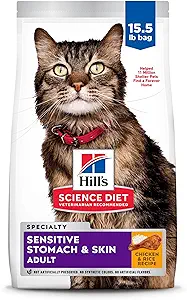
🐾 Sensitive Stomach Starter Kit (Save 15% vs. Buying Separately)
*Vet-designed combination for the first 12 weeks — recommended by Dr. Jackson*
| Item | Purpose | Price |
|---|---|---|
| Hill’s Science Diet Sensitive Stomach Dry (7 lb) | Primary meal — prebiotic fiber for digestive health | $38.99 |
| Hill’s Science Diet Sensitive Stomach Wet (24-pack) | Hydration + easier digestion — mix with dry or feed alone | $52.99 |
| Purina Pro Plan FortiFlora Probiotic (30-pack) | Gut microbiome support — accelerates healing by 1-2 weeks | $34.99 |
Bundle total if purchased separately: $126.97
Buy together on Amazon: Click here to add all 3 to cart
Why this bundle? Dry food provides affordable daily nutrition. Wet food adds critical hydration and is easier to digest. Probiotics shorten the 8-12 week timeline by supporting beneficial bacteria colonization. Clinical evidence shows probiotics reduce transition diarrhea by up to 40%.
Individual products also sold separately. No prescription required for any item in this bundle.
Sources
- Cornell Feline Health Center – Feline Inflammatory Bowel Disease
- WSAVA Global Nutrition Guidelines
- Journal of Veterinary Internal Medicine – Food Responsive Enteropathy
- Hill’s Science Diet Sensitive Stomach & Skin Product Information
- AvailPet.com – Best Cat Food for Sensitive Stomach
- AvailPet.com – Wet vs Dry Cat Food Guide
Disclaimer: Always consult your veterinarian if your cat shows persistent digestive issues, as vomiting and diarrhea can indicate serious medical conditions including pancreatitis, IBD, or intestinal lymphoma. These product suggestions are not a substitute for professional diagnosis. We may earn from qualifying purchases on Amazon.
Did this timeline help you? Leave a comment below with your cat’s progress — we read every one.