Key Takeaways: Blue Buffalo Basics Limited Ingredient Diet Cat Food
| Takeaway | Why It Matters |
|---|---|
| Limited ingredient = fewer than 10-12 key ingredients | Easier to identify triggers when there are fewer variables |
| Novel protein is the secret | Duck, rabbit, venison — proteins your cat hasn’t eaten before |
| No chicken, no corn, no wheat, no soy | These are the four most common feline allergens/irritants |
| Grain-free doesn’t mean better for everyone | But for some sensitive cats, removing grains helps |
| LID is an elimination diet tool | Feed exclusively for 8-12 weeks to confirm food allergies |
| Blue Buffalo Basics is our top OTC LID pick | Clean formula, novel protein (duck), and probiotics included |
Disclaimer: Always consult your veterinarian for persistent digestive problems. This information is vet-reviewed but not a substitute for professional medical advice.
Opening: When Standard Sensitive Stomach Food Isn’t Enough
Your cat has tried a standard sensitive stomach food — maybe Hill’s Science Diet — but after 8-12 weeks, symptoms haven’t improved. The vomiting continues. The litter box still shows loose stool. Your veterinarian now mentions “limited ingredient diet” (LID), and you’re confused.
What makes LID different from the “sensitive stomach” food you already bought? Is it just marketing? Do you really need to spend more money?
I’m Dr. Allona Jackson, DVM, and together with Ahashanul Hoque at AvailPet, we’ll explain exactly what a limited ingredient diet is, when to use it, and how Blue Buffalo Basics Limited Ingredient Diet (Duck & Potato) fits into a proper elimination diet protocol.
Let’s start with an honest comparison — because transparency builds trust.
First, Let’s Compare Ingredients: Hill’s vs. Blue Buffalo Basics
If you tried Hill’s Science Diet Sensitive Stomach first (as recommended in our previous guide), you might be wondering why it didn’t work. The ingredient comparison below tells the story.
| Ingredient Category | Hill’s Science Diet Sensitive Stomach | Blue Buffalo Basics LID (Duck) |
|---|---|---|
| #1 ingredient | Chicken (common allergen for many cats) | Deboned Duck (novel protein) ✅ |
| Grains | Yes — corn, brewers rice | No — grain-free ✅ |
| Common fillers | Corn gluten meal, whole grain corn | None (peas, tapioca, potatoes) ✅ |
| Chicken by-products | Present (chicken meal, chicken fat) | None — chicken-free ✅ |
| Probiotics | No (only prebiotic FOS) | Yes — 5 fermentation products ✅ |
| Prescription needed | No | No |
| Best for | Mild, intermittent symptoms | Suspected food allergies, failed standard diets |
Dr. Jackson’s take:
“Blue Buffalo Basics is the cleaner formula for cats who failed Hill’s or who have suspected multiple food sensitivities. The absence of chicken, corn, wheat, and soy makes it a true elimination diet candidate — something Hill’s Science Diet cannot claim.”
What Exactly Is a “Limited Ingredient Diet”? (No Marketing Speak)
Clinical definition: A true limited ingredient diet contains one animal protein source, one carbohydrate source, and essential vitamins/minerals — typically 10-12 ingredients total. The goal is to minimize variables so when a cat improves, you know exactly which ingredient was the trigger.
Blue Buffalo Basics Duck & Potato breakdown:
| Component | Source | Why Chosen |
|---|---|---|
| Single protein | Deboned Duck + Duck Meal | Novel protein — most cats haven’t eaten duck |
| Single carb sources | Peas, Tapioca, Potatoes | Easily digestible, grain-free, low risk of reaction |
| Fat source | Canola Oil + Flaxseed | Omega fatty acids for skin and coat health |
| Fiber | Pea Fiber + Pumpkin | Gentle digestive support, helps firm stools |
| Probiotics | 5 fermentation extracts (Enterococcus, Lactobacillus, etc.) | Supports gut microbiome during transition |
| Antioxidants | LifeSource Bits (blueberries, cranberries, turmeric, kelp) | Immune support for allergy-prone cats |
What’s missing (equally important):
- ❌ No chicken or poultry by-products
- ❌ No corn, wheat, or soy
- ❌ No artificial colors or preservatives
- ❌ No unnamed meat meals
The Clinical Mechanism: Why Novel Proteins Work for Food Allergies
By Dr. Allona Jackson, DVM
“Food allergies occur when a cat’s immune system mistakenly identifies a protein (most commonly chicken, beef, or fish) as a threat. The immune system creates antibodies against that protein, and every subsequent exposure triggers inflammation — vomiting, diarrhea, itchy skin, or ear infections. A novel protein — duck, rabbit, venison, or kangaroo — is one the cat’s immune system has never seen. Without prior exposure, there are no pre-existing antibodies. The immune system remains calm. This is why duck works when chicken fails. It’s not that duck is ‘better’ — it’s that the cat’s body doesn’t recognize it as an enemy.”
When Should You Switch to a Limited Ingredient Diet?
Not every cat with a sensitive stomach needs LID. Use this decision guide:
| Scenario | Try LID? | Why |
|---|---|---|
| Failed standard sensitive stomach food (e.g., Hill’s) after 8-12 weeks | ✅ Yes | Different protein, no grains, no chicken |
| Suspected chicken allergy (itchy skin + digestive issues) | ✅ Yes | Blue Buffalo Basics has zero chicken ingredients |
| Multiple food sensitivities suspected | ✅ Yes | Limited variables make trigger identification possible |
| Mild, intermittent symptoms only (occasional vomiting) | ❌ Try standard first | LID is more expensive; standard may work |
| Cat has confirmed IBD or chronic enteropathy | ✅ Yes (or prescription) | LID is often first-line before hydrolyzed diets |
| Cat has severe, confirmed food allergies | ❌ Skip to prescription | Hydrolyzed protein (Hill’s z/d) may be needed |
From your cluster article: “Choose Limited Ingredients: The best cat food for sensitive stomach features novel proteins (duck, rabbit) and easily digestible carbs to minimize triggers.”
Blue Buffalo Basics delivers exactly that recommendation.
How to Run an Elimination Diet Using Blue Buffalo Basics
An elimination diet is the gold standard for identifying specific food allergies or intolerances. Here’s the step-by-step protocol using Blue Buffalo Basics as your test diet.
Phase 1: Transition (Days 1-14)
| Days | Blue Buffalo | Old Food |
|---|---|---|
| 1-3 | 25% | 75% |
| 4-6 | 50% | 50% |
| 7-9 | 75% | 25% |
| 10-14 | 100% | 0% |
For cats with severe sensitivity: Extend each phase to 5-7 days (total 3-week transition).
Phase 2: Exclusive Feeding (Weeks 3-8)
Critical rules:
- Feed ONLY Blue Buffalo Basics — no treats, no table scraps, no flavored medications
- No other protein sources (no dental treats, no pill pockets unless prescription)
- Keep a daily symptom journal (use the tracker below)
What to track daily:
| Week | Vomiting (0-5) | Stool Score (1-5) | Appetite | Energy | Skin (itching, redness) |
|---|---|---|---|---|---|
| 3 | |||||
| 4 | |||||
| 5 | |||||
| 6 | |||||
| 7 | |||||
| 8 |
Stool scoring (1-5):
- 1 = Hard pellets (constipated)
- 2 = Firm, segmented (ideal)
- 3 = Log-shaped, moist (good)
- 4 = Soft, unformed (mild diarrhea)
- 5 = Watery (severe diarrhea)
Phase 3: Challenge Phase (Weeks 9-12)
If symptoms resolved during Phase 2, you now confirm the trigger.
Protocol:
- Introduce ONE old ingredient at a time (e.g., chicken, then corn, then beef)
- Feed that ingredient for 2-3 days while continuing Blue Buffalo Basics
- Watch for return of symptoms within 48-72 hours
- If symptoms return → you’ve identified a trigger
- Remove that ingredient permanently
Phase 4: Long-Term Management
- If symptoms resolved on Blue Buffalo Basics and no trigger identified → stay on LID long-term
- If one trigger identified → avoid that ingredient, may try other foods without it
- If no improvement after 8 weeks on LID → move to prescription hydrolyzed diet (Hill’s z/d or Royal Canin Selected Protein)
Blue Buffalo Basics LifeSource Bits — Marketing or Real Benefit?
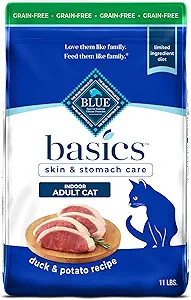
What they are: A cold-formed blend of antioxidants, vitamins, and minerals including blueberries, cranberries, turmeric, kelp, and barley grass.
How they’re different: Most pet foods add vitamins before high-heat extrusion, which destroys some nutrient value. Blue Buffalo cold-forms LifeSource Bits and adds them after cooking.
Dr. Jackson’s take:
“Cold-forming preserves nutrient integrity better than high-heat extrusion. The antioxidant blend — particularly turmeric and blueberries — supports immune function, which is clinically relevant for cats with food allergies because allergies are immune-mediated. That said, the bits aren’t essential. A cat would still do well on this food without them. They’re a nice bonus, not a gimmick.”
Verdict: Beneficial but not a reason to choose the food over another LID. The real value is the single novel protein and absence of common irritants.
Comparison Table: Blue Buffalo Basics vs. Other LID Options
| Product | Protein | Grain-free | Chicken-free | Probiotics | Prescription? | Best For | Amazon Link |
|---|---|---|---|---|---|---|---|
| Blue Buffalo Basics (Duck) | Duck | ✅ Yes | ✅ Yes | ✅ Yes | No | First LID trial, OTC | Buy Now |
| Royal Canin Selected Protein (Duck) | Duck | ❌ No | ✅ Yes | ❌ No | ✅ Yes | When OTC LID fails | Buy Now |
| Natural Balance LID (Duck) | Duck | ✅ Yes | ✅ Yes | ❌ No | No | Budget LID alternative | Buy Now |
| Hill’s Prescription Diet z/d | Hydrolyzed chicken | ❌ No | N/A | ❌ No | ✅ Yes | Severe, confirmed allergies | Buy Now |
| Purina Pro Plan Veterinary HA | Hydrolyzed soy | ❌ No | N/A | ❌ No | ✅ Yes | Severe allergies, soy-tolerant | Buy Now |
Our recommendation: Start with Blue Buffalo Basics (OTC, affordable, clean formula). If no improvement after 8 weeks, escalate to prescription options.
FAQs About Blue Buffalo Basics Limited Ingredient Diet Cat Food
1. Is limited ingredient diet the same as grain-free?
No. Grain-free removes only grains (wheat, corn, rice, barley). LID limits total ingredients AND typically removes grains, but they are different concepts. A food can be grain-free without being limited ingredient (e.g., grain-free food with chicken, beef, salmon, and 40+ ingredients). LID is about simplicity, not just grain removal.
2. Can I stay on LID forever?
Yes. If Blue Buffalo Basics resolves your cat’s symptoms, there is no harm in long-term use. It is a complete and balanced diet formulated for adult cats. Many cats with food sensitivities stay on LID for life.
3. Why duck instead of chicken?
Duck is a novel protein for most cats — meaning they have never eaten it before. Chicken is the #1 feline food allergen. If your cat has never eaten duck, their immune system won’t have pre-existing antibodies against it.
4. My cat refused Hill’s. Will she eat Blue Buffalo Basics?
Possibly — and often yes. Blue Buffalo Basics has a different texture (smaller kibble), different protein (duck has a stronger smell than chicken), and no corn (which some cats find unappealing). Many cats who reject Hill’s will eat Blue Buffalo. If your cat is extremely picky, try the wet version first.
5. Is Blue Buffalo Basics prescription?
No. Blue Buffalo Basics is available over-the-counter on Amazon and at pet retailers. No veterinary authorization is required. Only prescription diets (Royal Canin Selected Protein, Hill’s z/d, Purina HA) require vet approval.
6. How is this different from regular Blue Buffalo?
| Feature | Regular Blue Buffalo | Blue Buffalo Basics |
|---|---|---|
| Protein sources | Multiple (chicken, fish, etc.) | Single (duck) |
| Grains | Often contains | Grain-free |
| Ingredient count | 30-40+ | ~10-12 |
| Best for | Healthy cats | Cats with suspected food allergies |
7. Can I mix LID with other foods?
No — absolutely not during the elimination phase. Mixing defeats the entire purpose. If you add treats, table scraps, or another kibble, you introduce variables. You will not know whether improvement (or lack thereof) comes from the LID or the other food. Feed exclusively for 8 weeks.
8. What if my cat doesn’t improve on duck LID?
Try these next steps in order:
| Step | Action |
|---|---|
| 1 | Confirm you fed EXCLUSIVELY (no treats, no other foods) for full 8 weeks |
| 2 | Try a different novel protein LID (rabbit or venison) |
| 3 | If still no improvement, move to hydrolyzed prescription diet (Hill’s z/d) |
| 4 | If hydrolyzed fails, referral to veterinary dermatologist/internal medicine specialist |
9. Is Blue Buffalo Basics safe for kittens or seniors?
Adult cats only (1-7 years). Blue Buffalo Basics Duck & Potato is formulated for adult maintenance. For kittens or seniors, consult your veterinarian. Blue Buffalo does make a kitten LID formula (different protein options).
Final Verdict: Blue Buffalo Basics Limited Ingredient Diet
Best for:
- Cats who failed standard sensitive stomach foods (like Hill’s Science Diet) after 8-12 weeks
- Suspected chicken allergy (zero chicken ingredients — rare for OTC foods)
- First-line elimination diet before trying expensive prescription options
- Cats with mild to moderate food sensitivities affecting digestion AND skin
- Multi-cat households where only one cat needs LID (safe for all cats)
Not ideal for:
- Cats who need hydrolyzed protein (severe, confirmed allergies with anaphylaxis or severe IBD)
- Extremely picky eaters (duck has a strong flavor some cats reject)
- Budget-conscious owners (LID is more expensive than standard formulas: ~4.36/lbvs. 2.50/lb for standard)
- Kittens, pregnant/nursing cats, or seniors with special needs
Bottom line from Dr. Jackson:
“Blue Buffalo Basics Duck & Potato is my top over-the-counter recommendation for elimination diets. It removes the four most common feline irritants — chicken, corn, wheat, and soy — while introducing a genuine novel protein (duck). The inclusion of probiotics and the cold-formed LifeSource Bits are meaningful bonuses, not marketing fluff. If your cat fails this food after a proper 8-week exclusive trial, it’s time to move to prescription options like Royal Canin Selected Protein or Hill’s Prescription Diet z/d. But for most cats with suspected food sensitivities who have already failed standard ‘sensitive stomach’ formulas, this is the right next step.”
🐾 Elimination Diet Starter Kit (Blue Buffalo Bundle)
*Vet-designed combination for the 8-12 week elimination diet protocol*
| Item | Purpose | Price |
|---|---|---|
| Blue Buffalo Basics Duck & Potato Dry (11 lb) | Primary LID food for daily meals | $47.98 |
| Blue Buffalo Basics Duck Wet (12-pack) | Hydration + variety for picky eaters | $35.99 |
| Freeze-dried Duck Treats (single ingredient) | Elimination-safe treats (no other proteins) | $12.99 |
Bundle total if purchased separately: $96.96
Buy together on Amazon: Click here for Blue Buffalo Basics Duck & Potato
Why this bundle? Dry food provides affordable daily nutrition for the 8-week elimination phase. Wet food adds critical hydration and is often more palatable for picky cats transitioning from chicken-based foods. Single-ingredient duck treats ensure you don’t break the elimination diet — most commercial treats contain chicken, beef, or multiple proteins that would ruin your results.
Individual products also sold separately. No prescription required for any item in this bundle.
Sources
- Cornell Feline Health Center – Feline Inflammatory Bowel Disease
- WSAVA Global Nutrition Guidelines – Adverse Food Reactions
- Journal of Veterinary Internal Medicine – Food Responsive Enteropathy (2024)
- Blue Buffalo Basics Limited Ingredient Diet Product Information
- AvailPet.com – Best Cat Food for Sensitive Stomach
- AvailPet.com – Wet vs Dry Cat Food Guide
- Mueller, R.S., et al. (2023). Diagnosis of feline food allergy. Veterinary Dermatology.
Disclaimer: Always consult your veterinarian before starting an elimination diet, as vomiting and diarrhea can indicate serious medical conditions including pancreatitis, IBD, or intestinal lymphoma. Never restrict food completely. These product suggestions are not a substitute for professional diagnosis. We may earn from qualifying purchases on Amazon.
Has your cat tried a limited ingredient diet? Share your experience in the comments below — did duck work when chicken failed?