Key Takeaways
| Takeaway | Why It Matters |
|---|---|
| Hill’s Prescription Diet z/d cat food uses hydrolyzed chicken protein | Proteins broken down so small that immune system doesn’t recognize them |
| Prescription required | Must be sold under veterinary supervision — not available OTC |
| For severe allergies only | Not for mild sensitivity — try OTC options first |
| No chicken allergy concerns | Hydrolyzed chicken is safe even for chicken-allergic cats |
| Contains prebiotic fiber (ActivityBloc) | Supports gut microbiome during healing |
| 8-12 week trial minimum | Same timeline as other sensitive stomach foods |
Disclaimer: Always consult your veterinarian before starting a prescription diet. Hill’s Prescription Diet z/d cat food requires veterinary authorization. This information is vet-reviewed but not a substitute for professional medical advice. For OTC options, see our best cat food for sensitive stomach guide .
Opening: When Everything Else Has Failed
You’ve tried everything.
Hill’s Science Diet Sensitive Stomach — no improvement. Blue Buffalo Basics LID — your cat still vomits. Purina Pro Plan with probiotics — the diarrhea continues. Your veterinarian now mentions a prescription diet called “hydrolyzed protein,” and you’re staring at a bag of Hill’s Prescription Diet z/d cat food wondering: What makes this different? Do I really need a prescription? Will my cat even eat it?
I’m Dr. Allona Jackson, DVM, and together with Ahashanul Hoque at AvailPet, we’ll explain exactly what hydrolyzed protein means, when Hill’s Prescription Diet z/d cat food is appropriate, and why this is often the last stop before a veterinary internal medicine referral.
Before we dive in: If you haven’t already tried OTC options, start with our sensitive stomach cluster guide . Prescription diets like Hill’s z/d are for when those fail.
First, Let’s Understand What “Hydrolyzed” Actually Means
Hill’s Prescription Diet z/d cat food contains hydrolyzed chicken liver as its protein source. But what does “hydrolyzed” mean?
Simple explanation: Hydrolysis is a process that breaks protein molecules into tiny fragments — so small that a cat’s immune system no longer recognizes them as “chicken” (or as any protein at all).
Analogy: Imagine a novel written in English. A chicken-allergic cat’s immune system reads “chicken” and attacks. Hydrolysis is like shredding that novel into individual letters. The immune system sees “c h i c k e n” — individual letters — and doesn’t recognize the word. No immune response.
Clinical definition from Dr. Jackson:
“Hydrolysis uses water and enzymes to cleave peptide bonds between amino acids. A complete protein (like chicken) has a molecular weight of 10,000-60,000 daltons. Hydrolyzed proteins are broken down into fragments under 1,000 daltons — too small to cross-link IgE antibodies on mast cells. No cross-linking, no histamine release, no allergic reaction. This is why a chicken-allergic cat can safely eat hydrolyzed chicken protein.”
This is the key difference between Hill’s Prescription Diet z/d cat food and every OTC option we’ve reviewed previously.
Ingredient Deep Dive: What’s Actually in Hill’s Prescription Diet z/d?
| Ingredient | Role | Verdict |
|---|---|---|
| Brewers Rice | Carbohydrate source | ✅ Acceptable — highly digestible |
| Hydrolyzed Chicken Liver | Hydrolyzed protein | ✅ Key ingredient — safe for chicken-allergic cats |
| Rice Protein Concentrate | Plant protein | ✅ Acceptable — adds amino acids |
| Soybean Oil | Fat source (omega-6) | ✅ Acceptable |
| Coconut Oil | Fat source (MCTs) | ✅ May support gut health |
| Ground Pecan Shells | Fiber source | ⚠️ Unusual but safe |
| Dried Beet Pulp | Fiber | ✅ Prebiotic effect |
| ActivityBloc Digestion | Prebiotic fiber blend | ✅ Proprietary gut health support |
| Chicken Liver Flavor | Palatant | ✅ Flavor from hydrolyzed source — still safe |
What’s missing (important):
- ❌ No intact chicken protein
- ❌ No corn, wheat, or soy (though brewers rice is a grain)
- ❌ No artificial colors or preservatives
The honest truth: This is not a “natural” or “limited ingredient” food in the traditional sense. It’s a therapeutic food — formulated for medical necessity, not marketing appeal. The ingredient list includes items (brewers rice, ground pecan shells) that would raise eyebrows in an OTC food. But for a cat with severe allergies, function trumps fashion.
The Clinical Mechanism: How Hydrolyzed Protein Works for Severe Allergies
By Dr. Allona Jackson, DVM
“In a cat with a true food allergy — not just sensitivity — the immune system produces IgE antibodies against specific protein epitopes (the 3D shape of a protein molecule). Every time the cat eats that protein, those antibodies trigger mast cells to release histamine. The result: vomiting, diarrhea, pruritus (itching), ear infections, and sometimes more severe reactions. Hydrolyzed proteins are broken down so thoroughly that these epitopes no longer exist. The immune system has nothing to recognize. This is fundamentally different from a ‘limited ingredient diet,’ which simply introduces a novel protein the cat hasn’t seen before. Novel proteins work until the cat develops a new allergy — which can happen over time. Hydrolyzed proteins work indefinitely because the immune system cannot create antibodies against something it cannot see. Hill’s Prescription Diet z/d cat food uses hydrolysis to molecular weights under 1,000 daltons — far below the threshold for immune recognition. This is why it’s the standard of care for severe, confirmed feline food allergies.”
Hill’s Prescription Diet z/d vs. OTC Options: When to Escalate
This comparison is critical for understanding where Hill’s Prescription Diet z/d cat food fits in your treatment pathway.
| Feature | Hill’s z/d (Prescription) | Hill’s Science Diet (OTC) | Blue Buffalo Basics (OTC) | Purina Pro Plan (OTC) |
|---|---|---|---|---|
| Protein source | Hydrolyzed chicken | Intact chicken | Duck (novel) | Lamb + chicken meal |
| For chicken-allergic cats? | ✅ Yes (safe) | ❌ No | ✅ Yes (chicken-free) | ❌ No |
| Immune recognition | None (broken down) | Full | Full (novel protein only) | Full |
| Prescription required | ✅ Yes | No | No | No |
| Prebiotic fiber | ✅ Yes (ActivityBloc) | ✅ Yes (FOS) | ✅ Yes (chicory root) | ✅ Yes (chicory root) |
| Probiotics | ❌ No | ❌ No | ✅ Yes | ❌ No |
| Best for | Severe, confirmed allergies | Mild sensitivity | Mild-moderate, suspected allergies | Mild sensitivity |
The escalation ladder (from our article series):
| Step | Food | When to use | Link |
|---|---|---|---|
| 1 | Hill’s Science Diet | Mild, first-time sensitivity | Read timeline guide |
| 2 | Blue Buffalo Basics | Suspected chicken allergy, failed Step 1 | Read LID guide |
| 3 | Purina Pro Plan + probiotic | Mild sensitivity with skin issues | Read probiotic guide |
| 4 | Hill’s Prescription Diet z/d | Severe allergies, failed Steps 1-3 | You are here |
Do You Really Need a Prescription? (Yes — Here’s Why)
Hill’s Prescription Diet z/d cat food requires veterinary authorization. This is not a marketing gimmick.
Three reasons why:
| Reason | Explanation |
|---|---|
| Medical necessity | This food is for diagnosed medical conditions — not general use. Using it without a confirmed allergy is inappropriate and expensive. |
| Monitoring required | Cats on hydrolyzed diets need veterinary oversight to ensure nutritional adequacy and symptom resolution. |
| Legal requirement | Hill’s restricts distribution to veterinary channels only. Amazon will ask for your vet’s information at checkout. |
How to get the prescription:
- Schedule a veterinary appointment
- Discuss your cat’s history (including failed OTC trials)
- Your vet may recommend blood work or an elimination diet first
- Once prescribed, you can order Hill’s Prescription Diet z/d cat food through Amazon with vet approval , Chewy, or your vet’s office
Cost reality: Prescription diets are more expensive than OTC options. A 4 lb bag of Hill’s Prescription Diet z/d cat food costs approximately 44.99(11.25/lb), compared to $4-5/lb for OTC sensitive stomach foods. But for cats with severe allergies, it’s often the only solution.
Step-by-Step: Transitioning to Hill’s Prescription Diet z/d
Important: Even with hydrolyzed protein, transition gradually over 7-14 days. Sudden changes can cause digestive upset even in non-allergic cats.
Transition Schedule
| Days | Old Food | Hill’s z/d | Expected Symptoms |
|---|---|---|---|
| 1-3 | 75% | 25% | Minimal — some cats may refuse new food |
| 4-6 | 50% | 50% | Possible soft stool |
| 7-9 | 25% | 75% | Mild adjustment period |
| 10-14 | 0% | 100% | Full transition |
For cats with severe reactions to old food: Your veterinarian may recommend an abrupt switch (no transition). Follow their guidance.
12-Week Expectation Timeline (Same as OTC — Biology Doesn’t Change)
| Phase | Duration | What to Expect |
|---|---|---|
| Transition | Days 1-14 | Adjustment period |
| Early improvement | Weeks 3-4 | Vomiting frequency drops |
| Gut healing | Weeks 5-6 | Stool consistency improves |
| Full response | Weeks 8-10 | Skin/coat improvement noticeable |
| Maximum benefit | Weeks 10-12 | Complete symptom resolution (if food allergy was the cause) |
For a complete explanation of why 8-12 weeks is necessary, see our clinical timeline guide .
Comparison: Hill’s Prescription Diet z/d vs. Royal Canin Selected Protein
Both are prescription hydrolyzed diets, but they differ significantly.
| Feature | Hill’s Prescription Diet z/d | Royal Canin Selected Protein |
|---|---|---|
| Hydrolyzed protein source | Chicken | Varies (duck, rabbit, venison — not hydrolyzed) |
| Mechanism | Hydrolyzed (broken down) | Novel protein (intact, unseen) |
| Works for chicken allergy? | ✅ Yes | ✅ Yes (if duck/rabbit/venison chosen) |
| Prescription required | ✅ Yes | ✅ Yes |
| Prebiotic fiber | ✅ Yes (ActivityBloc) | ❌ No |
| Probiotics | ❌ No | ❌ No |
| Best for | Any protein allergy | Cats who won’t eat hydrolyzed diets |
Which to choose?
- Hill’s z/d: Better for cats with multiple protein allergies or who have failed novel protein trials
- Royal Canin Selected Protein: Better for cats who refuse to eat hydrolyzed diets (intact novel proteins taste more natural)
Week-by-Week Symptom Tracker for Hill’s z/d Users
Copy this table into a notebook. Track daily for 12 weeks.
| Week | Vomiting (0-5)* | Stool Score (1-5)** | Skin Itching (0-5)*** | Appetite | Energy |
|---|---|---|---|---|---|
| 1 | |||||
| 2 | |||||
| 3 | |||||
| 4 | |||||
| 5 | |||||
| 6 | |||||
| 7 | |||||
| 8 | |||||
| 9 | |||||
| 10 | |||||
| 11 | |||||
| 12 |
Vomiting scale (0-5):
- 0 = No vomiting
- 1 = Once in 7 days
- 2 = 2-3 times in 7 days
- 3 = Weekly
- 4 = Several times weekly
- 5 = Daily
Stool score (1-5):
- 1 = Hard pellets
- 2 = Firm, segmented (ideal)
- 3 = Log-shaped, moist
- 4 = Soft, unformed
- 5 = Watery
Skin itching scale (0-5):
- 0 = No scratching
- 1 = Occasional (once daily)
- 2 = Mild (few times daily)
- 3 = Moderate (frequent)
- 4 = Severe (constant)
- 5 = Self-trauma (hair loss, sores)
FAQ: Hill’s Prescription Diet z/d Cat Food (10 Questions)
1. What is Hill’s Prescription Diet z/d cat food used for?
It is used to manage confirmed food allergies in cats — specifically adverse food reactions causing skin issues (itching, ear infections, overgrooming) or digestive issues (vomiting, diarrhea). It is not for mild, intermittent sensitivity without a confirmed allergy diagnosis.
2. Does Hill’s Prescription Diet z/d cat food contain chicken?
Yes — hydrolyzed chicken. Unlike OTC chicken-based foods, the chicken protein in z/d is broken down so small that even chicken-allergic cats can safely eat it. This is the entire point of hydrolysis.
3. Why do I need a prescription?
Because this is a therapeutic food for diagnosed medical conditions. Your veterinarian needs to confirm that your cat actually has a food allergy (ruling out other causes like IBD, pancreatitis, or intestinal lymphoma) before starting a prescription diet. Order through Amazon with vet approval here .
4. How long until I see improvement with Hill’s Prescription Diet z/d cat food?
Most cats show improvement in 2-4 weeks (reduced vomiting, less itching). Full resolution of skin and digestive issues takes 8-12 weeks. For the complete timeline, see our detailed guide here .
5. Can I use Hill’s Prescription Diet z/d cat food without a prescription?
No. Amazon will ask for your veterinarian’s information at checkout and verify the prescription. This is legally required.
6. Is Hill’s Prescription Diet z/d cat food grain-free?
No. It contains brewers rice. Grain-free is not a priority for prescription therapeutic foods. The goal is hydrolyzed protein, not grain removal.
7. How is this different from Hill’s Science Diet Sensitive Stomach?
| Feature | Hill’s z/d (Prescription) | Hill’s Science Diet (OTC) |
|---|---|---|
| Protein | Hydrolyzed chicken | Intact chicken |
| For chicken allergy | ✅ Safe | ❌ Not safe |
| Prescription | ✅ Required | No |
| Best for | Severe, confirmed allergies | Mild sensitivity |
8. Will my cat eat Hill’s Prescription Diet z/d cat food? I heard hydrolyzed diets taste bad.
Some cats refuse it initially. Hydrolyzed proteins can have a bitter taste compared to intact proteins. Tips:
- Start with the wet version (more palatable)
- Mix with old food for 7-14 days (if not severely allergic)
- Warm the food slightly
- If still refusing after 5 days, ask your vet about Royal Canin Selected Protein (novel protein, not hydrolyzed)
9. Does Hill’s Prescription Diet z/d cat food contain probiotics?
No. It contains prebiotic fiber (ActivityBloc Digestion) to feed existing gut bacteria, but no live probiotics. If your cat needs probiotics, add FortiFlora — but consult your veterinarian first.
10. What if my cat doesn’t improve on Hill’s Prescription Diet z/d?
Options:
- Confirm you fed exclusively (no treats, no other foods, no flavored medications) for 8+ weeks
- Try Royal Canin Selected Protein (different prescription diet with intact novel proteins)
- Consider non-food causes: IBD, pancreatitis, intestinal lymphoma, hyperthyroidism
- Referral to a veterinary internist or dermatologist
If you haven’t tried OTC options first, go back to our best cat food for sensitive stomach guide — prescription diets are last-line, not first-line.
When to Choose Hill’s Prescription Diet z/d (And When Not To)
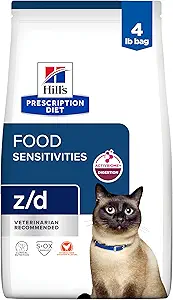
Choose Hill’s Prescription Diet z/d cat food if:
| Criterion | Explanation |
|---|---|
| Confirmed food allergy by vet | Elimination diet or blood work has identified food allergy |
| Failed OTC limited ingredient diets | Tried Blue Buffalo Basics (duck) or similar for 8+ weeks with no improvement |
| Failed novel protein trial | Tried duck, rabbit, venison — cat still symptomatic |
| Multiple protein allergies suspected | Cat reacts to chicken, beef, fish, AND novel proteins |
| Severe symptoms | Chronic diarrhea, weight loss, constant itching, ear infections |
Do NOT choose Hill’s Prescription Diet z/d cat food if:
| Criterion | Explanation |
|---|---|
| Mild, intermittent symptoms only | Try OTC first — see our cluster guide |
| No veterinary diagnosis | Get a diagnosis first. You may be treating the wrong problem. |
| Cat refuses hydrolyzed diets | Ask about Royal Canin Selected Protein instead |
| Budget constraints | Prescription diets are expensive (~11/lb).TryBlueBuffaloBasicsfirst( 4/lb). |
Final Verdict: Hill’s Prescription Diet z/d Cat Food
Best for:
- Veterinarian-confirmed food allergies (not just suspected)
- Cats who have failed OTC limited ingredient diets (Blue Buffalo Basics, etc.)
- Cats with multiple protein allergies (chicken, beef, fish, AND novel proteins)
- Severe symptoms: chronic diarrhea, weight loss, constant itching, ear infections
- Cats who need a long-term solution (hydrolyzed proteins work indefinitely)
Not ideal for:
- Mild, intermittent sensitivity without a confirmed allergy diagnosis
- First-time sensitive stomach issues (start with Hill’s Science Diet OTC)
- Cats who refuse to eat hydrolyzed diets (try Royal Canin Selected Protein instead)
- Budget-conscious owners (prescription diets are significantly more expensive)
Bottom line from Dr. Jackson:
“Hill’s Prescription Diet z/d cat food is the gold standard for confirmed feline food allergies — but it’s also the most expensive and restrictive option. I never recommend it as a first-line treatment. Start with OTC sensitive stomach foods. If those fail after proper 8-12 week trials, move to OTC limited ingredient diets like Blue Buffalo Basics. Only when those fail — and only after a veterinary diagnosis — should you consider prescription hydrolyzed diets like Hill’s z/d. This is the last stop before referral to a veterinary internist. For the right cat, it’s life-changing. For a cat with mild sensitivity, it’s overkill and overpriced. Know where your cat falls on that spectrum.”
Still unsure which food is right for your cat? Start at the beginning: Best Cat Food for Sensitive Stomach: Complete Guide .
🐾 Severe Allergy Starter Kit (Hill’s z/d Bundle)
Vet-prescribed combination for confirmed food allergies
| Item | Purpose | Price |
|---|---|---|
| Hill’s Prescription Diet z/d Dry Food (4 lb) | Primary hydrolyzed protein food | $44.99 |
| Hill’s Prescription Diet z/d Wet Food (24-pack) | Hydration + palatability (often better accepted) | $89.99 |
| Veterinary consultation | Prescription + monitoring | Varies |
Buy on Amazon (prescription required):
- Hill’s Prescription Diet z/d Dry Food
- Hill’s Prescription Diet z/d Wet Food (search within store)
Important: Amazon will ask for your pet and veterinarian information at checkout. Have this ready before ordering. No prescription? Schedule a veterinary appointment first.
Single-protein, single-ingredient treats (freeze-dried duck or rabbit) may be allowed — consult your veterinarian.
Sources
- Cornell Feline Health Center – Feline Inflammatory Bowel Disease & Food Allergies
- Journal of Veterinary Internal Medicine – Hydrolyzed Protein Diets for Feline Adverse Food Reactions (2024)
- Hill’s Prescription Diet z/d Product Information & Clinical Studies
- WSAVA Global Nutrition Guidelines – Adverse Food Reactions
- AvailPet.com – Best Cat Food for Sensitive Stomach
- AvailPet.com – How Long for Sensitive Stomach Food to Work
- AvailPet.com – Limited Ingredient Diet Guide
- AvailPet.com – Wet vs Dry Cat Food
Disclaimer: Hill’s Prescription Diet z/d cat food requires veterinary authorization. This article is for informational purposes only and does not constitute medical advice. Always consult your veterinarian before starting any prescription diet. Vomiting and diarrhea can indicate serious medical conditions including IBD, pancreatitis, and intestinal lymphoma — these must be ruled out before assuming food allergy. We may earn from qualifying purchases on Amazon.
Has your cat tried Hill’s Prescription Diet z/d? Did it work after OTC options failed? Share your experience in the comments below — and don’t forget to start with our complete sensitive stomach guide if you haven’t already.