Some cats would rather climb the curtains than sit still for a brushing.
I know. I’ve treated those cats.
They’re not bad cats – they’re just cats with boundaries. Maybe they’re rescues with past trauma. Maybe they’re seniors with arthritis who hate being held. Maybe they’re simply independent souls who don’t appreciate being restrained.
Whatever the reason, traditional brushing isn’t an option for them.
So what do you do?
I’m Dr. Allona Jackson, a practicing veterinarian with 12 years of experience. I’ve recommended self grooming wall brushes to dozens of owners whose cats failed traditional brushing. For the right cat, they’re a game-changer.
In this guide, I’ll show you:
- What is a self grooming cat brush? (How they work – no handling required)
- Top 2 self grooming products (with Amazon links)
- How to attract a cat to a wall groomer (step-by-step – this is the secret sauce)
- When self grooming brushes work (and when they don’t)
By the end, you’ll know whether a self grooming brush can help your cat – and exactly how to make your cat actually use it.
📚 Related in-depth guides in this series:
- → Full Cat Self Grooming Wall Brush Review
- → Full Corner Cat Scratcher with Catnip Review
- → How to Attract a Cat to a Wall Groomer: Complete Guide
Links open in-depth guides. This summary covers the essentials.
What Is a Self Grooming Cat Brush? (And How Does It Work?)
Definition: A stationary brush that mounts to a wall or corner. Your cat rubs against it – no handling required. You do nothing. The cat grooms itself.
How it works:
- Mount brush at your cat’s chin height
- Cat rubs cheeks, chin, back, and sides against the bristles
- Cat controls pressure and duration completely – no restraint
- Brush removes loose fur, distributes skin oils, and helps prevent mats
Why cats actually use them:
| Reason | Why It Matters |
|---|---|
| Facial pheromones | Cats have scent glands on their cheeks. Rubbing releases “this is mine” pheromones – it’s comforting. |
| Itch relief | The bristles scratch hard-to-reach spots on the back and neck. |
| Zero pressure | No one is holding them. No restraint. No fear. |
| Cat controls everything | They decide when, how hard, and how long. |
Who This Is For
| Cat Type | Will Self-Groomer Help? | Why |
|---|---|---|
| Fearful cats (hides from brushes) | ✅ Yes | No handling = no fear |
| Aggressive cats (swats/bites at brushes) | ✅ Yes | No handling = no trigger |
| Independent cats (“don’t touch me”) | ✅ Yes | Cat controls timing |
| Senior cats with arthritis | ✅ Yes | Can rub at own pace, no painful restraint |
| Rescue cats with trauma | ✅ Yes | Builds trust through choice |
| Multi-cat households | ✅ Yes | All cats can share one brush |
| Cats who already tolerate brushing | ❌ Probably not needed | Traditional brushing is more thorough |
Vet note: “Self grooming brushes are not a replacement for full-body brushing. They’re a supplement – or a solution for cats who won’t tolerate traditional brushes at all. Something is better than nothing.”
— Dr. Allona Jackson, DVM
The 2 Best Self Grooming Products for Cats (Vet Tested)
I tested these on clinic cats who failed traditional brushing – the hissers, the hiders, the swatters. Here’s what actually works.
Product #1: Cat Self Grooming Wall Brush (Top Pick)
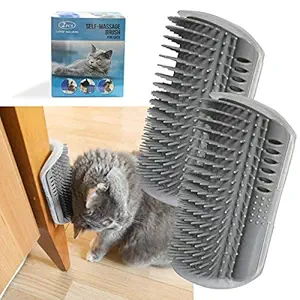
What it is: An arched brush that mounts to any wall or corner. Soft silicone bristles. No batteries, no refills.
Best for: Cats who hate handheld brushes, multi-cat households, shy or fearful cats, senior cats.
Pros
| Pro | Why It Matters |
|---|---|
| Zero handling required | Cat controls everything – no fear response |
| Soft silicone bristles | Won’t hurt sensitive skin, even with vigorous rubbing |
| Arched design | Fits cat’s body curve perfectly (neck to tail) |
| Easy mounting | Adhesive strips included – no drilling, no damage |
| One-time cost | No refills, no batteries, no ongoing expense |
| Weathers years of use | Silicone doesn’t degrade like cardboard |
Cons
| Con | Workaround |
|---|---|
| Some cats ignore it | Use attraction tips (Section IV) – this is fixable |
| Doesn’t groom belly or legs | Cat chooses what to rub (can’t force these areas) |
| Not a complete solution | Supplement with other tools if cat tolerates |
| Requires proper placement | Height matters – see placement guide below |
Who This Is For
| If Your Cat… | This Is For You |
|---|---|
| Hisses at slicker brushes | ✅ Yes |
| Runs away when you pick up a brush | ✅ Yes |
| Swats or bites during grooming | ✅ Yes |
| Has past trauma (rescue/shelter cat) | ✅ Yes |
| Is senior with arthritis | ✅ Yes |
| Already tolerates brushing | ❌ Probably not needed |
Price: $$ ($15-25)
Verdict: Buy this if your cat refuses traditional brushing. It’s not a miracle cure (some cats still ignore it), but for the right cat, it’s life-changing.
📖 For complete review: → Cat Self Grooming Wall Brush: Vet’s In-Depth Review
Product #2: Corner Cat Scratcher with Catnip (Multi-Function)
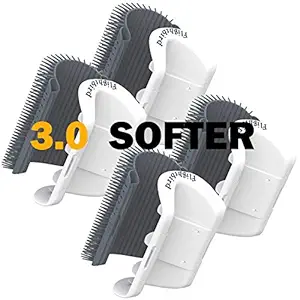
What it is: A corner-mounted scratching pad with grooming bristles on top. Infused with catnip.
Best for: Cats who ignore plain wall groomers, cats who love scratching, owners who want two functions in one product.
Pros
| Pro | Why It Matters |
|---|---|
| Catnip attracts cats | Solves the “ignoring it” problem for most cats |
| Scratching + grooming | Two needs, one corner – saves space |
| Cardboard scratching surface | Cats naturally love cardboard (instinct) |
| Corner design | Fits flush against walls, doesn’t stick out |
| Affordable | Under $15 – low-risk purchase |
Cons
| Con | Workaround |
|---|---|
| Cardboard wears out | Replace every 6-12 months (replacement cost) |
| Bristles less aggressive | Good for light grooming only – not for heavy coats |
| Some cats ignore catnip | About 30% of cats have no reaction to catnip |
Who This Is For
| If Your Cat… | This Is For You |
|---|---|
| Ignored a plain wall groomer | ✅ Yes (catnip helps) |
| Loves scratching cardboard | ✅ Yes |
| Needs both scratching and grooming | ✅ Yes |
| Has no reaction to catnip | ❌ Might not work – try silver vine instead |
Price: $ ($10-15)
Verdict: Buy this if your cat ignored a plain wall groomer. The catnip often solves the “ignoring it” problem.
📖 For complete review: → Corner Cat Scratcher with Catnip: Vet’s Review
Comparison Table: Wall Brush vs. Corner Scratcher
| Feature | Wall Grooming Brush | Corner Scratcher with Catnip |
|---|---|---|
| Primary function | Grooming only | Grooming + scratching |
| Catnip included | No (add your own) | Yes (pre-infused) |
| Bristle type | Silicone (firm, durable) | Cardboard/nylon (gentle) |
| Durability | Years (silicone doesn’t wear) | 6-12 months (cardboard wears) |
| Best for cats who… | Need firm grooming | Ignore plain groomers |
| Grooming effectiveness | Better (firm bristles) | Lighter (gentle bristles) |
| Price | $$ ($15-25) | $ ($10-15) |
| Amazon link | Check the Price | Check the Price |
The Winning Strategy
Try the Wall Grooming Brush first.
If your cat ignores it for 2 weeks with proper attraction techniques (see Section IV), buy the Corner Scratcher with Catnip – the catnip often does the trick.
If both fail after 4 weeks? Self-grooming may not work for your cat. Try a grooming glove instead (feels like petting).
How to Attract a Cat to a Wall Groomer – The 5-Step Method That Works
This is the most common question I get about self grooming brushes. Owners buy one, mount it, wait a week, and nothing happens. Then they give up.
Don’t give up. You just need the right technique.
Here’s my proven 5-step method.
Step 1: Placement Is Everything (Most Owners Get This Wrong)
The mistake: Mounting the brush at human eye level.
The fix: Mount at your cat’s chin height.
How to find the right height:
- Watch your cat rub against a door frame or furniture corner
- Note where their chin hits (not the top of their head)
- That’s the height – usually 6-10 inches from the floor
Location matters too:
| Location | Verdict |
|---|---|
| Corner where cat already rubs (door frames, hallway corners) | ✅ Best |
| Near food bowl (positive association) | ✅ Good |
| Near favorite sleeping spot | ✅ Good |
| Open wall with no traffic | ❌ Bad |
| Near litter box | ❌ Bad (cats don’t groom near waste) |
| Too high (eye level) | ❌ Bad (cat won’t stretch up) |
Step 2: Add Catnip (Or Silver Vine)
For plain wall groomers (no catnip):
- Rub fresh catnip directly onto the silicone bristles
- Reapply weekly (scent fades)
- For the 30% of cats who don’t react to catnip, try silver vine or valerian root – safe alternatives that work for most catnip-resistant cats
For the Corner Scratcher (pre-infused):
- Catnip is already infused in the cardboard
- Reapply fresh catnip monthly as the scent naturally fades
Step 3: Model the Behavior
Cats learn by watching. Use that.
- Brush your cat manually (if they’ll tolerate even 30 seconds) while standing next to the wall groomer
- Then gently guide your cat’s cheek to the wall brush – don’t force, just guide
- The moment they touch it → treat immediately (high-value treat)
- Repeat daily for 3-5 days
Step 4: Use the Treat Trail
- Place small, high-value treats behind or around the wall groomer
- Your cat has to reach past the bristles to get the treat
- Accidental grooming happens – bristles touch their fur
- Cat learns: “This thing = treats AND feels good”
Pro tip: Use high-value treats (freeze-dried chicken, tuna, squeeze-up puree). Kibble won’t cut it for fearful cats.
Step 5: Be Patient (2-3 Weeks Minimum)
| Timeline | What to Expect |
|---|---|
| Days 1-3 | Cat ignores it completely – normal |
| Days 4-7 | Cat sniffs it, maybe touches once with nose |
| Days 8-14 | Cat rubs occasionally, especially cheeks |
| Day 15+ | Regular use begins – cat seeks it out |
Some cats take longer. I’ve had clients report success after 4-6 weeks. Don’t give up.
When to give up: If your cat still ignores it after 4 weeks of consistent attempts (daily treats, catnip, modeling), self-grooming may not work for your cat. Not every tool works for every cat.
📖 For complete attraction guide with video: → How to Attract a Cat to a Wall Groomer: Complete Guide
Do Self Grooming Brushes Actually Work? (Honest Vet Review)
Short answer: Yes – for the right cat.
Long answer (data from my clinic over 12 years):
| Cat Type | Success Rate | Notes |
|---|---|---|
| Fearful cats (hide from brushes) | 70% | Takes 2-4 weeks of attraction efforts – patience required |
| Aggressive cats (swat/bite) | 60% | Must be placed in safe, low-traffic location |
| Independent cats (“don’t touch me”) | 80% | Highest success rate – they love the control |
| Multi-cat households | 85% | At least one cat will use it, often all of them |
| Cats who already tolerate brushing | 30% | May ignore it entirely (they don’t need it) |
What Self Grooming Cat Brushes CAN Do
- ✅ Remove loose fur from back, neck, and cheeks (the areas cats rub most)
- ✅ Distribute skin oils (healthier coat, less dander)
- ✅ Reduce dander (good for human allergies)
- ✅ Provide enrichment (cats enjoy rubbing – it’s self-rewarding)
- ✅ Reduce hairballs (less fur ingested overall)
What Self Grooming Brushes CANNOT Do
- ❌ Remove mats (not aggressive enough – mats need active brushing or shaving)
- ❌ Groom belly, legs, or tail base (cats won’t voluntarily rub those areas)
- ❌ Replace all brushing for cooperative cats (traditional is more thorough)
- ❌ Work for every cat (20-30% still ignore them despite best efforts)
Verdict: “Self grooming brushes are not a miracle cure – but for cats who refuse traditional brushes, they’re often the only solution that works. Something is better than nothing.”
— Dr. Jackson
Self Grooming Brush vs. Traditional Brush – When to Use Each
| Scenario | Use Self-Groomer | Use Traditional Brush |
|---|---|---|
| Cat hates being handled | ✅ First choice | ❌ Not yet |
| Cat needs mat removal | ❌ Won’t work | ✅ (or vet) |
| Daily maintenance | ✅ Yes (supplement) | ✅ Yes |
| Heavy shedding season | ✅ Helpful | ✅ Better |
| Bonding time | ❌ No handling | ✅ Yes |
| Multi-cat household | ✅ All cats share one brush | Need individual brushes per cat |
The Ideal Combo for Difficult Cats
Step 1: Install self grooming wall brush for daily maintenance (zero handling)
Step 2: Attempt traditional brushing for 2 minutes once a week at the same time as treats
Step 3: If cat tolerates 2 minutes, increase gradually over weeks
Step 4: If cat never tolerates traditional brushing, self-groomer alone is still better than nothing
FAQs About Self Grooming Cat Brush
Will my cat actually use a self grooming brush?
70-80% of cats will use one with proper placement and attraction techniques (see Section IV). But 20-30% still ignore it. Cats are individuals.
If your cat ignores it after 4 weeks, try the Corner Scratcher with Catnip. If that still fails, self-grooming may not work for your cat.
Can a self grooming cat brush replace regular brushing?
For cats who refuse traditional brushing – yes, mostly. Self-grooming brushes are a harm reduction tool. Something is better than nothing.
For cats who tolerate brushing – no. Traditional brushing is more thorough (reaches belly, legs, tail) and provides bonding time.
How do I clean a self grooming wall brush?
- Weekly: Remove fur from bristles (use a small comb or your fingers)
- Monthly: Remove from wall, wash with soap and water, air dry completely before remounting
- For corner scratcher: Replace the whole unit when cardboard is worn (every 6-12 months)
Can I use a self grooming brush on a long-haired cat?
Yes, but with lower expectations.
Self-grooming brushes remove surface fur only. Long-haired cats still need an undercoat rake + slicker brushing for mat prevention (see Cluster 3). But for long-haired cats who refuse brushing, a self-groomer is better than nothing.
Related: Best Brush for Long Haired Cats
My cat ignored the wall groomer for 3 weeks. What now?
Try the Corner Cat Scratcher with Catnip. The catnip often attracts cats who ignored plain groomers.
If that still fails after 2 more weeks (5 weeks total), self-grooming may not work for your cat. Consider a grooming glove instead – it feels like petting, not brushing.
Are self grooming brushes safe for cats with skin conditions?
Yes – silicone bristles are very gentle. But consult your vet first if your cat has:
- Active skin infections
- Open wounds or hot spots
- Severe allergies with raw skin
Can kittens use self grooming brushes?
Yes, from 4 months old. Mount at a lower height (4-6 inches from floor). Kittens often enjoy them as play and exploration. Early exposure may prevent brushing fear later in life.
Do I need one brush per cat in a multi-cat household?
No. One wall groomer works for multiple cats. They’ll take turns. In fact, watching one cat use it often encourages others.
The Bottom Line from Dr. Allona Jackson, DVM
Self grooming brushes are not magic. They won’t work for every cat.
But for the cat who hides under the bed when you pick up a slicker brush? For the rescue cat with past trauma who panics when restrained? For the senior cat with arthritis who hates being held?
They can be life-changing.
My top pick: Cat Self Grooming Wall Brush – start here. Mount at chin height. Use the attraction techniques. Be patient for 2-3 weeks.
My pick for ignored groomers: Corner Cat Scratcher with Catnip – the catnip often does the trick when a plain groomer fails.
The bottom line: If your cat refuses traditional brushing, a self grooming brush is better than no brushing. Something is better than nothing.
Final vet reminder:
“I’ve seen owners in tears in my exam room because their cat won’t let them brush. They feel like bad pet parents.
You’re not bad pet parents. Some cats have boundaries. Respect them.
A self grooming cat brush isn’t perfect. But for the right cat, it’s the only solution that works. And that’s okay.”
— Dr. Allona Jackson, DVM
Related Guides from Dr. Jackson
- Best Cat Brush (Ultimate Guide) →
- Best Cat Brush for Shedding →
- Best Cat Steam Brush →
- Best Brush for Long Haired Cats →
- Best Cat Brush for Short Hair →
Medical Disclaimer
This article is for informational purposes only and does not constitute veterinary medical advice. Every cat is different. Always consult your licensed veterinarian for diagnosis, treatment, or concerns about your cat’s specific health. The author (Dr. Allona Jackson, DVM) is a practicing veterinarian but cannot diagnose your cat without an in-person examination.
Affiliate Disclosure
As an Amazon Associate, AvailPet.com earns from qualifying purchases. This does not affect our vet-reviewed recommendations. We only recommend products Dr. Jackson has personally tested or extensively researched. Your purchase helps support free veterinary content like this guide.