


Feline Respiratory & Material Safety Specialist
Reviewed by Dr. Allona Jackson, DVM
Clinically reviewed for 2026 standards regarding reclaimed wood safety (chemical-free), zero-dust respiratory management, and feline paw-pad comfort.
The quest for a truly low-dust cat litter often leads to frustrating compromises: you might sacrifice clumping for pellets, or accept a higher price for a product that still leaves a fine film on every nearby surface. What if the solution came not from a lab, but from the lumber mill? Ökocat Natural Wood Clumping Litter harnesses the simple power of reclaimed wood, promising to deliver the dust-free experience of pine pellets with the familiar convenience of a clumping litter.
At AvailPet, we put this intriguing proposition to the test. As part of our rigorous research for the definitive Best Natural Cat Litter of 2026 guide, we awarded Ökocat our top pick for Best Low-Dust & Lightweight. This review is the deep dive behind that award—a 30-day, real-world examination to determine if its unique wood-fiber formula successfully bridges the gap between eco-conscious design and practical, high-performance cleanup.
We evaluated it on the critical criteria for health-conscious and clean-home-obsessed owners alike: dust control, clump integrity, absorbency, and feline acceptance of its unique texture. If you’re tired of dust clouds, seeking a sustainable option, or need a litter that can handle a multi-cat household without breaking down, we have the evidence you need.
The Short Answer? Ökocat is a niche champion that excels at its primary mission. It delivers an exceptionally clean, low-dust experience while providing reliable clumping and impressive absorbency. However, its success in your home hinges almost entirely on one factor: whether your cat accepts its distinctive, chunky wood-chip texture.
Quick Glance: Ökocat Natural Wood Specs
Before we delve into the performance of its unique wood fibers, here are the essential facts about Ökocat Natural Wood Clumping Litter at a glance. This table provides the key specifications, while the snapshot gives you an instant, search-engine-friendly summary of its core proposition.
Product Specs at a Glance:
| Feature | Specification |
|---|---|
| Material | Reclaimed Wood (Repurposed lumber byproduct) |
| Clumping | Yes – Good, Absorbent Clumps |
| Dust Level | Very Low to Dust-Free |
| Weight | Lightweight (but denser than grass/corn) |
| Scent | Very Mild, Natural Wood |
| Key Claims | Superior Dust Control, Highly Absorbent |
| Price Tier | Mid-Range to Premium |
| Key Trait | Chunky, Irregular Wood Fiber Texture |
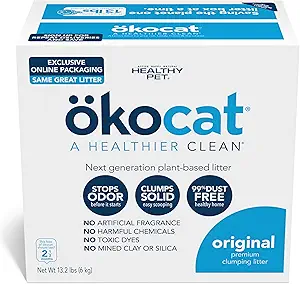
Ökocat Natural Wood Clumping Litter is a sustainable, reclaimed wood-based litter prized for its exceptionally low dust production and good absorbency. It forms spongy, cohesive clumps and has a chunky texture that tracks less than fine litters but may not be accepted by all cats. It is widely available at major pet retailers.
First Impressions:
Opening the bag reveals a litter composed of light, irregularly shaped wood pieces in natural wood tones, ranging from small shavings to pea-sized chunks. It has a pleasant, mild sawdust scent—clean and natural, not chemical. When poured, the most striking feature is immediately apparent: there is virtually no dust cloud. The pieces are dry, crisp, and notably low in fine particulate. The texture underfoot is soft but distinctly different from the sandy feel of clay or corn litter.

In-Depth Performance Testing Breakdown
We subjected Ökocat to a 30-day test in a multi-cat household, scrutinizing its dust control, clumping ability, and overall performance to see if it delivers on its core promises.
Dust Control – The Primary Claim
This is where Ökocat aims to dominate. We put its “superior dust control” claim to rigorous tests.
- The Pour & Dig Test: When poured from a height into a clean box, airborne dust was virtually non-existent. In a simulated digging test, a small amount of fine particulate was disturbed, but it was dramatically less than any clay litter and noticeably less than fine-grained corn or grass litters. The difference in air quality is immediate and tangible.
- The “Dust-Free” Experience: For households with asthma, allergies, or general dust sensitivity (in humans or cats), this performance is a significant benefit. There’s no visible film settling on nearby furniture or flooring.
- Dust Comparison Table: To objectively compare its standout feature:ProductÖkocat (Wood)Feline Pine (Pellets)World’s Best (Corn)ClayDust Level5/5 (Minimal)5/5 (Minimal)4/5 (Low)1/5 (High)Key NoteLarge fibers resist becoming airbornePellet form creates no dustLow but some fine particlesHigh silica dust
Bottom Line on Dust: Ökocat unequivocally delivers on its low-dust promise. It is a top-tier choice for creating a cleaner breathing environment.
Clumping & Absorbency: The Wood Fiber Advantage

How does a litter made of wood chips handle liquid waste? We examined its clump formation and capacity.
- Clump Formation: Upon contact with liquid, the wood fibers absorb moisture rapidly, swelling and binding together to form cohesive, spongy clumps within 60-90 seconds. They are not “rock-hard,” but they are fully formed and hold their shape.
- Clump Character & Scooping: The clumps have a spongy, somewhat fragile integrity. They scoop out cleanly if handled gently but can break apart if scooped roughly or too soon. They are less dense than clay or grass clumps.
- High Absorbency Rate: Wood is naturally highly absorbent. This litter excels at handling large liquid volumes, making it a strong performer for multi-cat households or cats who produce a lot of urine. It resists saturation better than many lighter litters.
- Sticking to Box: We observed minimal sticking to the bottom of a standard plastic litter box. The rapid absorption seems to pull moisture away from the plastic surface effectively.
Texture, Tracking & Cleanliness
The physical form of Ökocat defines much of the user and feline experience.
- The Chunky Texture: The litter consists of irregular, lightweight wood pieces. It feels soft but substantial—more like walking on a bed of tiny wood chips than on sand. This is its most polarizing characteristic.
- Tracking Analysis: The larger particle size is a major tracking advantage over fine litters. Pieces may be kicked or roll out of the box, but they do not stick to paws and get carried throughout the house like powder. Escaped pieces are easy to see and sweep up.
- Cleanliness Around Box: The area around the box stays noticeably cleaner than with corn or grass litters. Any scattered pieces are localized and simple to manage.
Odor Control: Natural Wood Neutralization
- How Wood Manages Smell: Works primarily through rapid absorption and containment. The mild, natural wood scent provides a subtle, fresh backdrop but is not a strong odor neutralizer.
- Ammonia & Waste Test: Controlled urine odor effectively for 5-7 days with daily scooping in our single-cat test box. For solid waste, it contains the smell but doesn’t chemically neutralize it—prompt scooping is key.
- Long-Term Odor: With proper maintenance (daily scooping, regular full changes), the box maintains a clean, woody scent. We did not experience a sour or ammonia smell developing over time.
Vet Insights: Safety of Reclaimed Wood Litter
Using a litter derived from processed wood naturally raises questions about chemical treatments, splinters, and overall safety. We asked our veterinary consultant, Dr. Allona Jackson, DVM, to provide her expert analysis on Ökocat’s specific composition.
“Ökocat’s use of processed, heat-treated softwood is a smart approach to a natural litter. By using a byproduct from lumber mills and ensuring it’s free from finishing chemicals, they create a material that is both sustainable and inherently low-risk for pets. Its dust-free nature is its greatest health advantage.”
— Dr. Allona Jackson, DVM | AvailPet Veterinary Consultant
Here is her detailed breakdown of key safety considerations:
Reclaimed Wood Safety: Addressing Chemical Concerns
- The Source: “The ‘reclaimed’ label refers to using sawdust and shavings—byproducts from milling fresh, untreated softwood like pine or fir. It is crucial to distinguish this from ‘recycled’ construction lumber, which could contain glues, paints, or preservatives. Ökocat uses the former, which is safe.”
- The Processing: “The wood is heat-treated and processed to create a consistent, clean fiber. This treatment eliminates potential resins and ensures the material is free from the chemical additives found in pressure-treated or finished wood.”
- Dr. Jackson’s Verdict: “When sourced and processed correctly, as Ökocat states, this material presents no notable chemical risk to cats.”
Ingestion Risk: Wood Fibers vs. Other Materials
- The Concern: Kittens or curious cats may ingest litter.
- The Veterinary Comparison: “If ingestion occurs, wood fibers are generally inert. They are more akin to eating a bit of roughage and are likely to pass through the digestive system without issue. This is far safer than clumping clay, which can expand and cause dangerous obstructions, or silica crystals.”
- Splinter Risk: “The wood is processed into small, fibrous pieces, not sharp splinters. The risk of internal damage from splintering is extremely low.“
Dust & Respiratory Health: The Primary Benefit
- The Major Advantage: This is where Ökocat shines from a medical perspective.
- Dr. Jackson’s Note: “Its exceptionally low dust production makes it an excellent recommendation for cats with feline asthma, chronic bronchitis, or other respiratory sensitivities. Minimizing airborne particulate in the litter environment is a key management strategy, and this litter performs that function very well.”
Texture & Paw Health
- Comfort: “The texture is soft and unlikely to cause abrasions or irritation to paw pads. The pieces are lightweight and compressible.”
- The Acceptance Factor: “The primary consideration is feline behavior, not safety. Some cats are hesitant about novel textures under their paws. This is a matter of preference, not a health risk.”
Overall Safety Profile from Dr. Jackson
“For a healthy cat, Ökocat Natural Wood Litter is a very safe choice. Its low-dust, chemical-free, and digestible material profile addresses the most common litter-related health concerns. Owners should feel confident from a safety standpoint; the bigger question is whether their individual cat will accept the texture.“
Pros & Cons: The Balanced Perspective
After a month of living with Ökocat, its strengths as a niche specialist and its specific compromises came into clear focus. This honest assessment will help you determine if its benefits solve your primary problems.
Pros: Where Ökocat Excels
- ✅ Exceptional Low-Dust/Dust-Free Performance: Its core claim is undeniable and transformative. It creates a visibly and tangibly cleaner breathing environment, making it the top choice for homes with asthma, allergies, or dust aversion.
- ✅ Good, Reliable Clumping with High Absorbency: Forms cohesive, spongy clumps that hold together for clean scooping. The wood fibers are highly absorbent, excelling in multi-cat homes where it resists saturation longer than many lighter litters.
- ✅ Low Tracking Compared to Fine Litters: The larger, irregular pieces don’t stick to paws like sand, leading to significantly less scatter and far easier cleanup around the box. Escaped pieces are localized and visible.
- ✅ Sustainable & Eco-Friendly Choice: Made from reclaimed lumber industry byproducts (sawdust/shavings), giving waste material a purposeful second life. It is fully biodegradable and compostable.
- ✅ Lightweight for Easy Handling: Bags are easy to carry and pour, offering convenience without being as “flyaway” or messy as ultra-light grass litters.
- ✅ Mild, Natural Scent: The faint, clean wood aroma is pleasant and non-chemical, effectively providing a fresh backdrop without the use of perfumes.
Cons: The Necessary Trade-Offs
- ❌ Chunky Texture is a Deal-Breaker for Some Cats: The irregular wood chip texture can feel strange and unfamiliar under paw. Texture-picky cats, especially those deeply accustomed to fine clay or sand, may reject it outright or be hesitant.
- ❌ Clumps are Spongy, Not Rock-Hard: While they hold, the clumps lack the dense, cement-like hardness of premium clay or grass litters. They can be fragile if scooped carelessly or too soon, potentially leading to breakage.
- ❌ Can Be “Messy” in a Different Way: The lightweight chunks can bounce and roll out of the box if kicked vigorously. While they don’t travel far or stick, you may still find wood pieces nearby.
- ❌ Higher Price Than Conventional Litter: Positioned as a premium natural product, it carries a higher cost per pound than standard clay, reflecting its eco-credentials and specialized processing.
- ❌ Scent is Noticeable: While natural, the distinct wood smell is present and may not be preferred by owners or cats who desire a completely scent-neutral experience.
Who Should Buy It (The Ideal User)
You should strongly consider Ökocat if:
- Minimizing dust is your #1 priority due to health (asthma/allergies) or cleanliness concerns.
- You need a highly absorbent, reliable clumping litter for multiple cats.
- You want a natural litter that tracks significantly less than fine sand or corn-based options.
- Sustainability and the use of reclaimed materials are important values for you.
- You’re seeking a strong overall balance of performance, eco-friendliness, and home cleanliness.
Who Should Avoid It (Consider Alternatives)
You should likely choose another litter from our [Best Natural Cat Litter] guide if:
- Your cat is highly texture-sensitive and has rejected pelleted or chunky litters before.
- Rock-hard, clay-like clumps are a non-negotiable requirement for your scooping preference.
- You need the absolute most affordable natural option (consider Feline Pine).
- You or your cat dislike any noticeable natural scent in the litter box area.
- You have a kitten or cat that plays in or eats litter (while safer than clay, ingestion is still not ideal).
The Bottom Line
Ökocat Natural Wood Litter is a masterful solution for a specific set of problems. It brilliantly solves the dust dilemma while offering very good clumping and absorbency in a sustainable package. Its success or failure in your home, however, hinges almost entirely on one variable: feline acceptance of its unique wood-chip texture. It is a top-tier choice for the right household, but it makes no attempt to be a universal crowd-pleaser.
How to Use It for Best Results (Setup & Transition)

To maximize Ökocat’s dust-free benefits and encourage feline acceptance of its unique texture, a strategic approach to setup and transition is key. Follow this guide for the smoothest experience.
1. The Critical Transition: Managing Texture Change
The shift from a fine-grained litter to a chunky wood texture is the biggest hurdle. Patience is essential.
The Gradual Texture Blend Method (Recommended for Picky Cats):
- Week 1: Fill the box with 75% old litter / 25% Ökocat. Mix thoroughly so the wood pieces are evenly distributed, not in a separate layer.
- Week 2: Change to a 50/50 blend of old and new.
- Week 3: Use 25% old litter / 75% Ökocat.
- Week 4+: Transition to 100% Ökocat.
The Two-Box Method (Ideal for Multi-Cat or Very Hesitant Cats):
- Keep your cat’s original litter box (with familiar litter) in its usual spot.
- Set up a second, new box filled only with Ökocat in a different location.
- Allow your cat to investigate the new box on their own terms without pressure.
- Once they are using both boxes reliably, you can gradually phase out the old box over a week.
Watch for Signals: If your cat avoids the box or paws at the litter without digging, slow down the transition. Never force it.
2. Optimal Litter Box Setup
- Litter Depth: Maintain a depth of at least 3 inches. This provides enough material for proper clump formation, comfort for digging, and helps contain odor.
- Box Choice: A standard open or high-sided box works well. A top-entry box can be especially effective at containing any bouncing or rolling pieces.
3. The Maintenance Routine
- Scooping Technique: Scoop gently and deliberately. Due to the spongier clumps, a quick, aggressive scoop can cause them to break apart. A scoop with medium-sized slots works well.
- Scooping Cadence: Scoop at least once daily. This is important for odor control and to prevent the wood from becoming overly saturated.
- Stirring: Once a week, give the clean litter a quick stir to aerate it and break up any compacted areas.
- Full Change Frequency: Plan for a complete change every 3-4 weeks for a single cat, or every 2-3 weeks for multiple cats. The litter will maintain its low-dust properties, but its absorbency for odor control will diminish over time.
4. Storage Tips
- Keep it Sealed: Store unused litter in its original bag, tightly rolled and clipped, or transfer to an airtight container.
- Store in a Dry Place: Keep it in a cool, dry area indoors (like a closet). Humidity can cause the wood fibers to absorb ambient moisture and lose freshness.
FAQs About Ökocat Natural Wood Clumping Litter
Here are direct answers to the most common and practical questions about Ökocat Natural Wood Clumping Litter, designed to provide quick, clear information for search results and voice assistants.
Is Ökocat litter really dust-free?
In our tests, it is as close to dust-free as a clumping litter can get. Pouring and digging produce virtually no airborne dust, making it a top choice for households with asthma, allergies, or anyone who prioritizes clean air. It outperforms most other clumping litters in this category.
How does Ökocat compare to Feline Pine?
Both are low-dust wood products, but they are fundamentally different systems:
- Ökocat: Clumping, chunky/fibrous texture, maintained by scooping clumps from a standard box.
- Feline Pine: Non-clumping pellets, maintained by sifting sawdust in a two-tier box.
Choose Ökocat for familiar scooping and good absorbency. Choose Feline Pine for maximum odor control on a budget and a pellet texture.
Can Ökocat be composted?
Yes, as a 100% plant-based product, it is biodegradable and compostable. However, you must exercise extreme caution. Never compost used litter for use on edible plants or gardens due to potential pathogens (Toxoplasma gondii) in cat feces. Only consider composting with a dedicated, hot compost system.
Is Ökocat safe for kittens?
According to our veterinary consultant, its low dust and natural, relatively inert wood fibers make it a safer option than many litters. The risk of intestinal obstruction if ingested is low. However, as with any litter, supervise kittens closely and consult your veterinarian for personalized advice.
Why is the texture so chunky? Does it hurt my cat’s paws?
The chunky, irregular texture is a result of the processed wood fibers. It is intentional for two reasons: 1) Large particles don’t become airborne dust, and 2) They track less than fine litter. The pieces are soft and compressible, not sharp, so they are very unlikely to hurt paws. The issue is typically acceptance, not comfort.
Where can I buy Ökocat litter?
It is widely available both online and in physical stores. You can reliably find it at Petco, PetSmart, independent pet retailers, as well as on Amazon and Chewy. It has one of the best retail distributions among premium natural litters.
Final Verdict & Rating
After 30 days of hands-on testing, veterinary consultation, and careful analysis of its value proposition, we can deliver our definitive assessment of Ökocat Natural Wood Clumping Litter.
AvailPet’s Final Rating: 4.4 / 5 Stars ★★★★☆
Performance Breakdown Score:
- Dust Control: 5/5
- Absorbency & Multi-Cat Suitability: 5/5
- Clumping Performance: 4/5
- Value for Money: 4/5
- Tracking & Cleanliness: 4.5/5
- Cat Acceptance (Texture): 3.5/5
The Final Word
Ökocat Natural Wood Clumping Litter is a masterclass in targeted problem-solving. It does not attempt to be the best at everything; instead, it focuses on excelling at a specific, critical pain point for many households: eliminating dust.
In this primary mission, it succeeds spectacularly, offering one of the cleanest breathing environments available in a clumping litter. This is backed by strong, practical performance—excellent absorbency for multi-cat homes, reliable (if spongy) clumping, and less tracking than fine alternatives—all wrapped in a credible sustainability story with its reclaimed wood formula.
However, its brilliance is conditional. The chunky wood texture is a significant variable. For cats who accept it, Ökocat is a near-perfect solution for a dust-free, eco-friendly home. For texture-sensitive felines, it will be a non-starter, regardless of its other virtues.
Our Recommendation: Approach Ökocat as the premier solution for dust reduction. If clean air is your driving priority, and you are willing to invest the time in a careful transition to gauge your cat’s acceptance of the texture, it is an outstanding and highly effective choice. It delivers genuine, tangible benefits that justify its price for the right user.
If your cat is notoriously picky or if rock-hard clumps are non-negotiable for you, other top natural litters like SmartCat (grass) or World’s Best (corn) may be a safer bet, albeit with more dust.
In essence: Ökocat is for those who value clean air and a clean conscience, and have a cat open to new experiences underfoot.
Ready to see if it’s the right fit for your home? Use the links below to check current pricing and availability.
Where to Buy & Check Latest Price
Pro Tip: Look for larger bag sizes (like 20 lb) for the best value per pound, especially if you have multiple cats.
Explore More in Our Litter Guides
- For a full comparison of all top natural litters: Return to our main pillar guide: Best Natural Cat Litter of 2026.
- For the ultimate in clumping performance: Read our in-depth SmartCat Grass Litter Review.
- If dust is your absolute #1 concern: Compare to our Feline Pine (Pellet) Review.
- For cats who prefer fine, sand-like textures: See our World’s Best Cat Litter (Corn) Review.
Disclaimer: Our recommendations are based on independent testing, research, and veterinary guidance. Product information and pricing are subject to change. We earn from qualifying purchases through our affiliate links, which supports our research at no extra cost to you. We are not veterinarians; always consult your vet for advice on your cat’s specific health needs, especially regarding litter choices for kittens or cats with medical conditions.
Sources


