Does your cat have chronic soft stool, excessive gas, itchy skin, or frequent ear infections?
These are classic signs of food sensitivity. But here’s the catch that most cat owners — and even some veterinarians — miss: the culprit is rarely grain.
I’m Dr. Allona Jackson, DVM, and at AvailPet.com, I see this every week. An owner spends 50% more on grain-free food, convinced their cat is allergic to corn or wheat. But after a proper elimination diet, we discover the real trigger is chicken — the #1 feline food allergen — or beef, fish, or dairy.
That’s why I’m writing this Hill’s Science Diet grain free cat food (sensitive stomach and skin) review with complete honesty. This formula isn’t magic. It’s not “hypoallergenic.” And despite the “grain free” label, it contains chicken.
Let me help you understand exactly what this best grain free cat food for sensitive stomach can — and cannot — do for your cat.
The Amazon data shows 4.7 stars from 1,554 reviews, with 1,000+ bags bought last month. But before you buy, read this entire review. You might save yourself money — and your cat’s health.
📖 This article is part of our complete Hills Science Diet Cat Food guide.
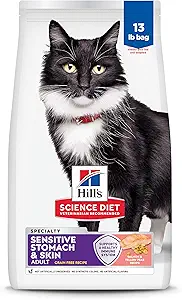
Quick Product Snapshot (From Amazon Data)
| Feature | Detail |
|---|---|
| Brand | Hill’s Science Diet |
| Formula | Adult Sensitive Stomach & Skin Grain Free |
| Flavor | Salmon & Yellow Pea (updated formula) |
| Size options | Multiple sizes available (13 lb bag shown: 67.99→5.23/lb) |
| Best price per lb | 13 lb bag ($5.23/lb) |
| Amazon rating | 4.7 ★★★★☆ (1,554 reviews) |
| Amazon’s Choice | ✅ Yes |
| Bought in past month | 1,000+ |
| Coupon available | 20% off with Subscribe & Save |
| Vet recommended | #1 Veterinarian Recommended Brand |
| Key claim | Triple support: stomach, skin, immune system |
The Truth About Grain-Free Cat Food (Dr. Jackson Explains)
Before we dive into this specific formula, let me clear up widespread confusion about grain-free cat food.
The Dog vs. Cat Difference
You may have heard that grain-free diets caused heart disease (dilated cardiomyopathy) in dogs. That does NOT apply to cats. Cats are obligate carnivores — they have no documented risk of grain-free related heart disease.
So Is Grain-Free Better for Cats?
No — for the vast majority of cats.
| Claim | Truth |
|---|---|
| “Grain-free is healthier for all cats” | ❌ False. Most cats digest grains perfectly fine. |
| “Grains are fillers” | ❌ False. Grains provide fiber, vitamins, and energy. They serve real nutritional purposes. |
| “Grain-free helps with allergies” | ⚠️ Partially true — but only 5-10% of cats with food allergies are actually allergic to grains. The other 90-95% react to animal proteins (chicken, beef, fish). |
When Should You Consider Grain-Free?
- ✅ Confirmed grain allergy (diagnosed by elimination diet with your vet) — this is rare
- ✅ Cat has chronic soft stool on grain-inclusive diets after ruling out other causes
- ✅ Owner preference (but be aware you’re paying 30-50% more for no proven benefit for most cats)
Dr. Jackson’s take: *”Only about 5-10% of cats with food allergies are actually allergic to grains. The vast majority react to chicken, beef, or fish. Before spending 2-3x more on grain-free food, do a proper elimination diet with your vet to confirm grain sensitivity. Otherwise, you’re probably wasting money on a solution that doesn’t match the problem.”*
Updated Formula Features: Triple Support (2025-2026)
Hill’s has updated this formula with triple support for three interconnected systems:
| Support Area | Key Ingredients | What It Does |
|---|---|---|
| Stomach (Digestive Health) | FOS prebiotic fiber, highly digestible formula | Gentle on stomach, optimal nutrient absorption, reduces soft stool |
| Skin & Fur Health | Vitamin E, Omega-3 & Omega-6 fatty acids (from salmon and fish oil) | Healthy skin, lustrous coat, reduced itching and dandruff |
| Immune System | Clinically proven antioxidants (Vitamins C+E) | Supports overall immune health, helps fight infection |
Dr. Jackson’s take: “The triple support approach makes sense clinically. Cats with skin issues often have digestive issues — they’re connected through inflammation. The immune system sits underneath both. Addressing all three simultaneously is smarter than just slapping ‘grain-free’ on the bag as a marketing claim.”
Ingredients Analysis (Dr. Jackson’s Breakdown)
First 10 ingredients (from Amazon label):
- Salmon
- Yellow Peas
- Potato Starch
- Chicken
- Chicken Fat
- Potato Protein
- Chicken Meal
- Potatoes
- Pea Protein
- Chicken Liver Flavor
Critical Warning for Chicken-Allergic Cats
This formula contains chicken (ingredients #4, #5, #7, #10). If your cat has a confirmed chicken allergy, this formula will not solve your cat’s symptoms. Despite the “grain free” and “salmon” marketing, chicken is present throughout this food.
Here’s what each ingredient means for your cat:
| Ingredient | Good? | Why It Matters |
|---|---|---|
| Salmon (#1) | ✅ Excellent | Named fish protein source — novel protein for many cats (great for chicken-sensitive cats if they tolerate salmon) |
| Yellow Peas | ✅ Acceptable | Plant protein and carbohydrate. Replaces grains. Fine for most cats, but some have pea sensitivity. |
| Potato Starch | ✅ Acceptable | Carbohydrate binder. Helps kibble hold shape. |
| Chicken (#4) | ⚠️ CAUTION | This is NOT chicken-free. Cats with confirmed chicken allergy will react to this formula despite “grain-free” label. |
| Chicken Fat | ✅ Good | High-quality energy source. Fat doesn’t typically trigger allergies (proteins do). Usually safe for chicken-allergic cats. |
| Potato Protein | ✅ Acceptable | Plant protein concentrate. Adds protein without animal allergens (except chicken is already present). |
| Chicken Meal | ⚠️ CAUTION | Concentrated chicken protein. Another source of chicken allergen. |
| Potatoes | ✅ Acceptable | Carbohydrate source. |
| Pea Protein | ✅ Acceptable | Concentrated plant protein. |
| Chicken Liver Flavor | ⚠️ CAUTION | Natural flavor derived from chicken. May trigger allergies in sensitive cats. |
Key Additions for Sensitive Cats:
| Ingredient | Purpose |
|---|---|
| FOS (Fructooligosaccharides) | Prebiotic fiber — feeds healthy gut bacteria, reduces soft stool |
| Dried Beet Pulp | Natural fiber for digestive health |
| Omega-3 & 6 fatty acids | Anti-inflammatory, skin/coat health |
| Vitamins C+E | Antioxidants for immune support |
| Taurine | Essential for heart and eye health — non-negotiable |
| Apples, Cranberries, Carrots, Broccoli | Natural sources of vitamins and antioxidants |
Dr. Jackson’s honest take: “This is a solid grain-free formula with excellent digestive and skin support. But I’m frustrated by the marketing — many owners buy this thinking it’s ‘hypoallergenic’ or ‘chicken-free.’ It’s not. If your cat has a confirmed chicken allergy, this formula will trigger symptoms. Read the label carefully before buying.”
Honest Limitations — When the “Grain Free” Label Misleads
Let me be very clear about three critical limitations of this formula.
Limitation #1: This Is NOT Chicken-Free
This formula contains chicken (ingredients #4, #5, #7, #10).
If your cat has a confirmed chicken allergy — the #1 feline food allergen — this formula will not solve the problem. Symptoms of chicken allergy include:
- Chronic itching (especially head and neck)
- Recurrent ear infections
- Overgrooming leading to bald spots
- Scabs or miliary dermatitis (small bumps on skin)
- Chronic soft stool or diarrhea
What to do instead: Choose a true novel protein diet (duck, rabbit, venison, or kangaroo) from brands like Rayne Clinical Nutrition, Royal Canin Selected Protein, or Hill’s Prescription Diet d/d.
Limitation #2: Grain Allergies Are Rare
Only 5-10% of cats with food allergies are actually allergic to grains. Most cats who “improve” on grain-free diets are actually improving because:
- They’re reacting to a different ingredient in their old food (preservatives, artificial colors, low-quality protein)
- The new food has higher overall quality or different fat source
- Owner confirmation bias (you want it to work, so you see improvement)
Dr. Jackson’s challenge: *”Before spending 30-50% more on grain-free food, do a proper elimination diet with your vet to confirm grain sensitivity. You may be wasting money on a solution that doesn’t match the problem. I’ve seen owners spend thousands on grain-free food over years when their cat’s real problem was chicken — which costs the same as regular food to avoid.”*
Limitation #3: Not for Diagnosed Medical Conditions
Skip this formula if:
| Condition | Why to Skip | What to Use Instead |
|---|---|---|
| Inflammatory bowel disease (IBD) | Needs hydrolyzed protein (molecules broken down so small they don’t trigger immune response) | Hill’s Prescription Diet z/d or Royal Canin HP |
| Chronic pancreatitis | Needs low-fat prescription diet | Hill’s Prescription Diet i/d low fat |
| Kidney disease (Stage 2+) | Salmon and pea protein may have higher phosphorus than regular formulas | Hill’s Prescription Diet k/d |
| Kitten under 1 year | Needs DHA for brain development and higher protein | Hill’s Science Diet Kitten Food |
| Senior cat 11+ with muscle wasting | Needs higher protein for sarcopenia | Hill’s Science Diet Senior 11+ |
Dr. Jackson’s honesty: “Grain-free is a marketing category, not a medical treatment. If your cat has real medical issues, see your vet. Don’t self-prescribe grain-free as a cure-all for IBD, pancreatitis, or kidney disease. You could delay proper treatment and make your cat worse.”
What Amazon Reviews Reveal (1,554+ Ratings)
4.7 stars from 1,554 reviews. 1,000+ bought in the past month.
What Owners Love:
- ✅ “My cat’s chronic diarrhea cleared up within 2 weeks of switching to this formula. I cried happy tears.”
- ✅ “The itching stopped. No more scabs on her neck after 3 years of suffering.”
- ✅ “My picky eater actually loves the salmon flavor. She refused every chicken-based food we tried.”
- ✅ “Her coat is so soft now — noticeably different after 1 month. Like a different cat.”
Common Complaints (Handled Honestly):
| Complaint | Dr. Jackson’s Response |
|---|---|
| “My cat’s symptoms got worse after switching” | Your cat may be allergic to salmon or peas, not grains. This formula contains multiple potential allergens (salmon, chicken, peas, potatoes). Work with your vet on a proper elimination diet. |
| “Very expensive compared to regular Hill’s” | True. Grain-free ingredients (peas, potatoes, salmon) cost more than corn/wheat. Ask yourself: does your cat actually need grain-free? If not, save money with Adult 1-6 which costs 30-50% less. |
| “My cat refused to eat it” | Some cats don’t like salmon flavor. Try the grain-free chicken recipe (if chicken allergy is ruled out) or mix with old food for 14-21 days. Sensitive cats are often picky. |
| “Still having soft stool after 6 weeks on this food” | This formula may not address your cat’s specific sensitivity. Consider prescription hydrolyzed protein diet (Hill’s z/d or Royal Canin HP) or a limited ingredient diet with a truly novel protein like duck or rabbit. |
👉 Read all 1,500+ reviews on Amazon
Sensitive Stomach vs. Skin Issues — What’s the Connection?
The gut-skin axis in cats: Digestive health and skin health are directly connected through inflammation and immune function.
| Digestive Issue | Possible Skin Manifestation |
|---|---|
| Chronic soft stool | Dry, flaky skin from malabsorption |
| Excessive gas | Itching, overgrooming (discomfort translates to skin-focused behavior) |
| Inflammatory bowel disease (IBD) | Eosinophilic granuloma complex (lip ulcers, skin plaques) |
| Food allergy (any protein) | Miliary dermatitis (small scabs, especially on head/neck and along the back) |
How This Formula Addresses Both:
- FOS prebiotic fiber — supports healthy gut bacteria (improves digestion, reduces inflammation)
- Omega-3 & 6 fatty acids — reduce systemic inflammation (improves skin, coat, and gut)
- Highly digestible formula — reduces GI upset, improves nutrient absorption
- Vitamin E + antioxidants — supports immune system which mediates both gut and skin health
Dr. Jackson’s clinical observation: *”I’ve seen cats with ‘mystery’ itching and soft stool resolve completely on this formula. But I’ve also seen cats with the same symptoms get worse. The difference is whether the trigger is grain, chicken, salmon, or peas. You won’t know without a proper elimination diet — which takes 8-12 weeks of feeding a single novel protein and carbohydrate source.”*
Feeding Guide for Sensitive Cats
Transition is critical for sensitive cats. Rushing causes GI upset and can create food aversion.
Dr. Jackson’s Sensitive Cat Transition Protocol (14-21 days):
| Phase | Days | Old Food | New Food |
|---|---|---|---|
| 1 | 1-5 | 80% | 20% |
| 2 | 6-10 | 60% | 40% |
| 3 | 11-15 | 40% | 60% |
| 4 | 16-21 | 20% | 80% |
| 5 | 22+ | 0% | 100% |
Signs to slow down: If you see soft stool, gas, vomiting, or refusal to eat, go back 2 phases and extend each phase by 2-3 days.
Daily Feeding Guide (Adult cats 1-6 years):
| Cat Weight | Daily Amount (cups) | Frequency |
|---|---|---|
| 6–8 lb | 1/4 – 1/3 cup | 2 meals |
| 9–11 lb | 1/3 – 1/2 cup | 2 meals |
| 12–14 lb | 1/2 – 2/3 cup | 2 meals |
| 15+ lb | 2/3 – 3/4 cup | 2 meals |
Dr. Jackson’s Tips for Sensitive Cats:
- Use a slow feeder bowl — eating too fast triggers vomiting, especially in sensitive cats
- Add warm water — helps digestion, increases hydration, and makes food more aromatic (appealing to picky cats)
- No table scraps — one piece of human food can trigger symptoms and undo weeks of progress
- Keep a symptom journal — track stool quality (firm/soft/watery), itching severity (scale 1-10), ear infections, and vomiting. This helps your vet identify patterns.
- Single protein source only — don’t feed this food PLUS fish treats PLUS chicken treats. Stick to one protein during the trial period.
How to Save Money on Hill’s Science Diet Grain Free Cat Food
Grain-free is more expensive. Here’s how to minimize the cost.
| Size | Approximate Price | Cost per lb | Best For |
|---|---|---|---|
| Small bag (check Amazon) | Varies | Highest ($7-9/lb) | Trial before committing (2-3 weeks) |
| 13 lb bag | $67.99 | $5.23/lb | Best one-time purchase value |
| Subscribe & Save (13 lb + 20% off) | $54.39 | $4.18/lb | ✅ Best value overall |
Dr. Jackson’s money-saving tip: “Before buying a large 13 lb bag, buy a small bag (or ask your vet for a sample) to confirm your cat tolerates the formula. Nothing is worse than spending $70 on food your cat refuses or reacts to. If the small bag works, switch to Subscribe & Save on the 13 lb bag for 20% off recurring.”
But honestly: If your cat doesn’t have confirmed grain sensitivity, save your money and buy the regular Adult 1-6 or Indoor formula. Grain-free is 30-50% more expensive with no proven benefit for most cats.
👉 Subscribe & Save on Amazon — 20% off
Who Is This Formula For? (And Who Should Skip It)
Best For:
- ✅ Cats with confirmed grain allergy (rare — diagnosed by elimination diet with your vet)
- ✅ Cats with chronic soft stool or gas that didn’t improve on standard grain-inclusive sensitive stomach formulas
- ✅ Cats with dry, flaky skin or dull coat (omega-3/6 benefit regardless of grain status)
- ✅ Cats who prefer salmon flavor over chicken (and don’t have salmon allergy)
- ✅ Owners who prefer grain-free for personal reasons (with awareness of higher cost and no proven benefit for most cats)
Skip It If:
- ❌ Confirmed chicken allergy → this formula contains chicken. Choose a true novel protein diet (duck, rabbit, venison, kangaroo)
- ❌ Confirmed salmon allergy → this formula has salmon as #1 ingredient. Choose Hill’s grain-free chicken recipe instead (if chicken allergy ruled out)
- ❌ Kitten under 1 year → needs DHA and higher protein in Kitten formula
- ❌ Senior cat 11+ with muscle wasting → needs higher protein in Senior 11+
- ❌ Cat with inflammatory bowel disease (IBD) → needs prescription hydrolyzed protein diet (Hill’s z/d or Royal Canin HP)
- ❌ Cat with chronic pancreatitis → needs low-fat prescription diet
- ❌ Budget-conscious owner → grain-free costs 30-50% more. Consider Adult 1-6 if cat tolerates grains
- ❌ No symptoms → if your cat is healthy on regular food, grain-free offers no proven benefit. Don’t fix what isn’t broken.
Grain Free vs. Other Hill’s Formulas (Quick Comparison)
| Formula | Best For | Key Difference | Price |
|---|---|---|---|
| Grain Free (this article) | Confirmed grain sensitivity (rare) or skin/stomach issues | No corn/wheat/soy, salmon #1, FOS prebiotic | $$$ |
| Adult 1-6 Standard | Healthy adults with no sensitivities | Contains grains (wheat, corn). Lower cost. | $ |
| Indoor | Indoor cats (hairball control) | Contains grains + powdered cellulose | $$ |
| Perfect Weight | Overweight cats | Contains grains but adds L-Carnitine for weight loss | $$ |
| Regular Sensitive Stomach (grain-inclusive) | Sensitive stomach without grain allergy | Contains rice/barley, chicken protein, lower cost | $$ |
📖 See our complete Hills Science Diet Cat Food guide for all formulas.
FAQs About Hill’s Science Diet Grain Free Cat Food
Is grain-free cat food better for cats?
No — for most cats. Cats have no biological requirement for grain-free diets. Grains provide fiber, vitamins, and energy. Unless your cat has a confirmed grain allergy (rare, 5-10% of food-allergic cats), grain-free offers no proven health benefits and costs significantly more (30-50% premium).
Dr. Jackson’s bottom line: *”If your cat is healthy on regular food, don’t switch to grain-free. You’re paying 30-50% more for no benefit. Spend that money on annual vet visits instead.”*
Does this Hill’s grain-free formula contain chicken?
Yes. Despite being “grain-free” and featuring salmon as the #1 ingredient, this formula contains chicken (ingredients #4, #5, #7, #10). If your cat has a confirmed chicken allergy, this formula will trigger symptoms. Choose a true novel protein diet (duck, rabbit, venison) instead.
What’s the difference between this formula and the regular Hill’s Sensitive Stomach (with grain)?
| Feature | Grain Free (this) | Regular Sensitive Stomach |
|---|---|---|
| Grains | None (peas/potatoes instead) | Contains rice, barley |
| Protein source | Salmon + chicken | Chicken |
| Price | $$$ (4.18−5.23/lb) | $$ (3.00−4.00/lb) |
| Best for | Confirmed grain allergy | General sensitive stomach (no grain allergy) |
Recommendation: Try the regular Sensitive Stomach formula first (costs less). Only upgrade to grain-free if your cat fails the grain-inclusive version after a proper 8-week trial.
Is this formula good for cats with IBD (inflammatory bowel disease)?
Maybe, but not typically. Cats with IBD often need hydrolyzed protein prescription diets (Hill’s z/d, Royal Canin HP) where protein molecules are broken down so small they don’t trigger an immune response. This grain-free formula still has intact proteins (salmon, chicken, peas) which can trigger IBD flares.
Dr. Jackson’s guidance: “Work with your vet — don’t self-prescribe grain-free for IBD. Most IBD cats need prescription diets, not over-the-counter grain-free options. You could waste months and money while your cat suffers.”
How long does a 13 lb bag last?
| Cat Weight | Daily Portion | Bag Lifespan |
|---|---|---|
| 8 lb cat | 1/3 cup | 12-14 weeks |
| 10 lb cat | 1/2 cup | 10-12 weeks |
| 12 lb cat | 2/3 cup | 8-10 weeks |
For a multi-cat household with two cats: divide these estimates in half.
Will this formula help with my cat’s itching?
It depends on what’s causing the itching:
| Itch Cause | Will This Help? |
|---|---|
| Grain allergy (rare, 5-10% of cases) | ✅ Yes, within 4-6 weeks |
| Chicken allergy (common) | ❌ No — this formula contains chicken |
| Salmon allergy | ❌ No — salmon is #1 ingredient |
| Environmental allergies (pollen, dust mites) | ❌ No — food change won’t help |
| Flea allergy dermatitis | ❌ No — treat fleas instead |
Dr. Jackson’s guidance: *”Food allergy only causes 10-20% of cat itching. Before buying expensive grain-free food, rule out fleas (even indoor cats get fleas) and environmental allergies with your vet. You may be treating the wrong problem.”*
Can kittens eat this formula?
No. Kittens under 1 year need:
- Higher protein levels
- DHA for brain and eye development
- Different calcium/phosphorus ratios for bone growth
- More calories per pound of body weight
Feed Hill’s Science Diet Kitten Food until 12 months, then transition to adult formula.
Is this formula good for urinary health?
Indirectly, yes, but not specialized. The formula is highly digestible and contains taurine (essential for heart and eyes). However, it does NOT have the controlled mineral blend (reduced magnesium and phosphorus) that Hill’s standard formulas have for urinary health.
Dr. Jackson’s warning: “Cats with a history of urinary crystals or blockages should stick with Adult 1-6 Standard or prescription c/d. Don’t switch to grain-free for urinary issues — you’re removing the protective mineral control.”
My cat has soft stool on this food. What should I do?
Step-by-step protocol:
Step 1: Slow down transition. Sensitive cats need 14-21 days, not 7-10. Go back to 50/50 mix for another week.
Step 2: Add a probiotic. Purina Pro Plan FortiFlora or VetriScience Probiotic Everyday can support gut bacteria during transition.
Step 3: Rule out other causes. Have you changed treats? Table scraps? New environment? Stress causes soft stool too.
Step 4: If soft stool persists beyond 3 weeks after full transition, your cat may be sensitive to salmon, peas, or potatoes. Try:
- Hill’s regular Sensitive Stomach (grain-inclusive, chicken-based)
- A limited ingredient diet with a truly novel protein (duck, rabbit)
Step 5: If still no improvement, see your vet. Chronic soft stool can indicate IBD, parasites, or other medical conditions.
How does the price compare to other grain-free cat foods?
| Brand | Approximate Cost per lb | Key Difference |
|---|---|---|
| Hill’s Grain Free (this) | 4.18−5.23/lb (Subscribe & Save) | Vet-recommended, triple support formula (stomach+skin+immune) |
| Blue Buffalo Grain Free | 3.50−4.50/lb | Lower vet recommendation, higher carbohydrate content |
| Purina Beyond Grain Free | 3.00−4.00/lb | Lower omega-3 fatty acid content |
| Royal Canin Grain Free | 5.00−6.00/lb | More expensive, similar quality to Hill’s |
| Taste of the Wild Grain Free | 2.50−3.50/lb | Lower cost, but fewer digestive support ingredients |
Dr. Jackson’s take: *”Hill’s is mid-range for grain-free. You can find cheaper options, but you lose the triple support (stomach + skin + immune) and the #1 vet recommendation. If budget is tight and your cat tolerates grains, skip grain-free entirely — Adult 1-6 costs $3-4/lb and works for most cats.”*
👉 Get the 13 lb bag on Amazon — Subscribe & Save for 20% off
Quick Price Comparison Table
| Size | Approximate Price | Cost per lb | Best For |
|---|---|---|---|
| Small bag (check Amazon) | Varies | Highest ($7-9/lb) | Trial (2-3 weeks) |
| 13 lb bag | $67.99 | $5.23/lb | Best one-time value |
| 13 lb + Subscribe & Save | $54.39 | $4.18/lb | ✅ Best overall value |
Conclusion: Dr. Jackson’s Final Take
Hill’s Science Diet Grain Free Cat Food (Sensitive Stomach & Skin) is a well-formulated option for cats with confirmed grain allergies — but that’s a much smaller population than marketing suggests.
The triple support formula (stomach, skin, immune) is clinically sound. The salmon as #1 ingredient provides novel protein for cats who have failed chicken-based diets. The FOS prebiotic fiber genuinely helps digestive health.
But here’s what the “grain free” label won’t tell you:
- This formula contains chicken — useless for chicken-allergic cats (the #1 feline food allergen)
- True grain allergies affect only 5-10% of food-allergic cats — most cats don’t need grain-free
- Most cats don’t need grain-free — you’re paying 30-50% more for no proven benefit for the average healthy cat
Dr. Jackson’s final note: “I recommend this formula strictly for cats with confirmed grain sensitivity who have failed cheaper, grain-inclusive sensitive stomach diets. For everyone else, save your money and buy regular Hill’s Science Diet. Don’t chase ‘grain-free’ as a marketing trend — chase the diet that actually solves your cat’s symptoms based on proper diagnostic testing.”
Your Action Plan:
- Before buying: Confirm grain allergy with your vet (elimination diet takes 8-12 weeks)
- If chicken allergy is suspected: Skip this formula (contains chicken). Choose a true novel protein diet instead.
- If you buy: Start with a small bag, transition over 14-21 days
- If it works: Switch to 13 lb bag + Subscribe & Save for best value
- If symptoms persist: Your cat may be allergic to salmon, chicken, or peas — not grains. See your vet.
Disclaimer: As an Amazon Associate, AvailPet earns from qualifying purchases. This helps us maintain honest, vet-written content. Thank you for your support.
– Dr. Allona Jackson, DVM
AvailPet.com | Veterinary Contributor