Canine Orthopedics & Breed-Specific Health Specialist
Reviewed by Dr. Allona Jackson, DVM
Clinically reviewed for POMC gene hunger management, joint-growth-rate nutrition, and 2026 EIC genetic screening protocols.
The Labrador Retriever Puppies has held the title of America’s most popular dog breed for decades—and for good reason. Their smiling faces, wagging tails, and unwavering loyalty are the stuff of family legend. But bringing home that bouncy, wiggly Labrador puppy means welcoming a powerhouse of energy, appetite, and joyful chaos into your life. Successfully navigating the puppy phase requires more than just love; it demands a strategic understanding of their unique drives and needs. This is where many well-intentioned owners find themselves overwhelmed.
In this definitive guide, Dr. Allona Jackson, DVM translates her veterinary expertise into your essential roadmap for raising a healthy, well-mannered Lab. We’ll cover everything from curbing their famous chewing and managing their Olympic-level energy to proactive health care that sets the stage for a long, vibrant life.
This deep dive builds upon our foundational philosophy of matching the right dog to the right family, which you can explore in our cornerstone resource: Best Dog Breeds for Families. Let’s ensure your Labrador Retriever Puppies grow into the perfect companion you know they can be.
The Proactive Health Start: A Lab’s Foundation
Your Labrador puppy’s goofy grin and boundless energy are powered by a remarkable physiology that requires specific, informed care. A reactive approach—waiting for problems to arise—is not sufficient for this breed. Your strategy must be proactive and preventative, focusing on the areas where Labs are genetically most vulnerable. This is the cornerstone of ensuring your playful puppy matures into a healthy, active adult.
Dr. Jackson’s Labrador-Specific Health Protocol
As a veterinarian, I emphasize that your first line of defense is choosing a breeder who does the recommended health testing. Your second is the care protocol you implement at home.
1. Joint Health: The Non-Negotiable Priority
Labradors are prone to hip and elbow dysplasia. These developmental conditions are influenced by genetics, nutrition, and exercise.
- The Breeder’s Role: Reputable breeders will provide OFA (Orthopedic Foundation for Animals) or PennHIP certification for both hips and elbows of the parent dogs. This is your single best predictor of your puppy’s joint future.
- Your Role:
- Nutrition: Feed a large-breed puppy formula exclusively. These diets have controlled calcium and phosphorus levels to promote a slower, steadier growth rate, allowing joints to form properly.
- Controlled Exercise: Avoid high-impact activities (jumping from heights, forced running on pavement, intense fetch on hard surfaces) until growth plates close (around 18-24 months). Focus on controlled leash walks, swimming, and soft-surface play.
- Weight Management: Keep your puppy lean. You should always be able to easily feel their ribs. Excess weight is catastrophic for developing joints.
2. The Unique Genetic Risk: Exercise-Induced Collapse (EIC)
This is a Labrador-specific concern. EIC is a genetic disorder where otherwise healthy, fit dogs can experience weakness, collapse, and even loss of consciousness after periods of intense exercise or excitement.
- Action Step: A responsible breeder will have genetically tested the parent dogs for the EIC mutation and will breed to avoid passing it on. Ask to see these test results.
3. The #1 Lifelong Challenge: Mastering the Labrador Appetite
The stereotype is real: Labradors possess a unique genetic variation that affects hunger signals, making them seem perpetually starving. This isn’t just a quirk; it’s a serious health management issue.
- The Goal: Prevent a lifetime of obesity and its associated problems (arthritis, diabetes, heart disease).
- The Strategy:
- Measure Meals: Never free-feed. Use a measuring cup and follow the bag’s guidelines for projected adult weight, adjusting to keep your puppy lean.
- Choose the Right Fuel: Reiterating the importance of a large-breed puppy formula. High-quality options like Purina Pro Plan Large Breed Puppy or Hill’s Science Diet Large Breed Puppy are formulated for this need.
- Use Tools: A slow-feed bowl or a food puzzle is not a luxury; it’s essential equipment to slow down eating (preventing bloat and vomiting) and provide mental stimulation.
- Account for Treats: Training treats count toward daily calories. Use small, low-calorie options or portion out some of their daily kibble for training.
4. The Core Vaccination & Prevention Schedule
Follow your veterinarian’s precise schedule, which will typically include:
- DHPP Vaccine: (Distemper, Hepatitis, Parvovirus, Parainfluenza) in a series of puppy shots.
- Rabies Vaccine: As required by law.
- Leptospirosis & Bordetella: Based on your geographic risk and lifestyle (e.g., swimming, boarding).
- Parasite Prevention: Monthly heartworm prevention (which also controls many intestinal parasites) and flea/tick control are non-negotiable year-round.
The Essential Pre-Puppy Shopping List (Lab-Tested)
Labrador Retriever puppies are not just puppies; they are durability-testing machines with the jaw strength of a crocodile and the enthusiasm of a tornado. Standard pet supplies often don’t survive the first week. This list, curated by Dr. Jackson, prioritizes safety, longevity, and practicality to save you money, frustration, and potential vet visits.
Dr. Jackson’s Lab-Proof Puppy Kit
The goal is to buy it once. Invest in these key items from the start.
| Product | Purpose & Vet Note | Why It’s Essential for Labs |
|---|---|---|
| Indestructible Chew Toys (Kong Extreme, GoughNuts, West Paw Zogoflex) | Satisfies powerful chewing instinct safely. Vet Note: Avoid hard antlers, nylon bones, or hooves that can fracture teeth. | Labradors are prolific, powerful chewers. Flimsy toys are choking hazards and destroyed in minutes. These protect your possessions and their dental health. |
| Heavy-Duty Crate (Impact Dog Crate, Ruff Land Kennel, or reinforced wire crate) | Secure confinement for safety, travel, and housetraining. | A determined Lab puppy can bend or break out of a flimsy crate, leading to destructive (and dangerous) roaming. This is a critical safety investment. |
| Indestructible Bed (K9 Ballistics, Kurgo Loft) | Provides a designated, comfortable resting spot. | Most beds are shredded in days. Chew-proof beds are worth the upfront cost to provide a proper place to settle. |
| Undercoat Rake & Deshedding Tool (Furminator, SleekEZ) | Manages the prolific shedding of their dense double coat. | Labradors shed heavily year-round. Starting a grooming routine early with the right tools prevents mats and controls fur buildup in your home. |
| Treat-Dispensing Puzzle Toys (Kong Wobbler, Outward Hound puzzles) | Provides essential mental stimulation and slows down eating. | A mentally bored Lab is a destructive Lab. These toys engage their problem-solving skills and turn mealtime into a brain game, tiring them out. |
| High-Impact Fetch Toys (ChuckIt! Ultra Balls, Tuffy’s rings) | For safe retrieval games. | Labs live to fetch. These toys are designed to withstand relentless chewing and outdoor abuse without falling apart. |
| 6-Ft Training Leash & Secure Harness (Biothane long-line, Kurgo Tru-Fit Harness) | For control and safe walks without neck strain. | Lab puppies are strong pullers. A front-clip harness gives you control and protects their developing trachea. A sturdy leash is a must. |
| Enzymatic Cleaner & Portable Carpet Cleaner (Rocco & Roxie, Bissell Little Green) | For accident clean-up. NON-NEGOTIABLE. | You will have accidents. Enzymatic cleaners break down odors completely to prevent re-soiling. A portable cleaner is invaluable for carpets. |
🛒 Pro Tip: We’ve compiled our top picks for these lab-tested essentials into a Labrador Puppy Starter Kit for easy, reliable shopping.
Puppy-Proofing for a Lab: The Extra Mile
Given their strength, curiosity, and food drive, you must be thorough:
- Trash & Recycling: Use locking lids or store in a latched cabinet.
- Counters & Tables: Assume they can and will reach. Never leave food unattended.
- Household Chemicals & Medications: Store in high, locked cabinets.
- Electrical Cords: Use cord protectors or hide them behind furniture.
- Create a “Puppy Zone”: Use an exercise pen (x-pen) attached to their crate to create a safe, contained area for unsupervised play. This protects your home and your puppy.
Taming the Energy: Exercise & Training from Day One
Welcome to the core challenge and joy of raising a Labrador: channeling their magnificent drive. A Labrador without an outlet is a Labrador finding its own outlets—often in the form of shredded furniture, obsessive digging, or frantic barking. Your mission isn’t to suppress their energy, but to harness it through smart exercise and clear communication. Done right, this builds a focused, happy companion.
The Labrador Exercise Equation: Mind + Body
Physical exercise alone will simply build a more athletic dog. You must also exhaust their brain.
- The Daily Minimum: A good starting rule is a minimum of one hour of structured activity, split into multiple sessions, plus constant mental engagement.
- Puppy-Safe Activities: Short leash walks, sniffaris (letting them lead and explore on a long line), gentle fetch on soft grass, and swimming (a natural, low-impact exercise for Labs).
- The Mental Workout: A 15-minute training session or a challenging food puzzle can be more tiring than a 30-minute walk.
Bite Inhibition & “Land Shark” Management
Labrador puppies are notoriously mouthy. This isn’t aggression; it’s how they interact. Your goal is to teach them what is acceptable to put their mouths on.
- The “Yipe & Redirect” Method:
- When teeth touch skin, let out a high-pitched “YIPE!” (like a hurt littermate).
- Immediately freeze and withdraw attention for 3-5 seconds.
- Then, offer an approved chew toy and praise lavishly when they take it.
- Consistency is Key: Every family member must react the same way. Mixed signals will confuse your puppy.
- Provide Ample Outlets: Always have a variety of textures available (rubber, rope, plush) to satisfy the chewing urge.
Foundational Training for Safety & Sanity
These are not just tricks; they are essential management tools for a powerful breed.
- “Leave It” / “Drop It”: The Life-Saving Command.
- Why: For a food-obsessed scavenger, this command can prevent them from eating something toxic or dangerous.
- How: Start with a low-value treat in your closed fist. Say “leave it.” The moment they stop nosing/pawing and look away, mark with “yes!” and reward with a different, higher-value treat from your other hand.
- Rock-Solid Recall (“Come!”): Using Their Drive as the Reward.
- Why: To call them off distractions, out of water, or back to safety.
- The Lab Method: Use their retrieving instinct. Practice on a long line. Throw a favorite toy, let them chase, then call “Come!” as you gently reel them in. When they get to you, reward with enthusiastic praise and the toy for a quick game of tug. Never call them to you for something negative (like ending play).
- “Place” or “Mat” Command: Teaching an “Off Switch.”
- Why: Labs need to learn to settle amid household activity. This provides a safe, calm spot during meals, when guests arrive, or when you need a break.
- How: Use a portable mat or bed. Lure them onto it with a treat, say “Place,” and reward. Gradually increase the duration they must stay on the mat before receiving the treat.
Training Tools & Resources
- The Right Gear: A well-fitted harness (like the Kurgo Tru-Fit) prevents pulling strain. A 15-30 ft biothane long line is perfect for safe, distance recall practice in parks.
- Professional Guidance: Enroll in a positive-reinforcement puppy class. The controlled socialization and structured learning are invaluable. For at-home learning, structured online programs like SpiritDog Training’s “Ultimate Puppy Program” offer excellent, step-by-step guidance for busy families.
Dr. Jackson’s Advice: “Training a Lab is a conversation, not a command. They are eager partners. If they’re not ‘listening,’ it’s usually because the reward isn’t valuable enough, they’re confused, or they need more mental/physical exercise first. Keep sessions short, fun, and end on a success.”
The First Year Timeline: Milestones & Challenges
Raising a Labrador Retriever puppy is a dynamic, ever-changing journey. Understanding the developmental stages you’ll navigate helps you anticipate challenges, celebrate milestones, and adjust your approach. Here is your month-by-month roadmap for that critical first year.
Your Labrador Puppy’s First Year: A Developmental Roadmap
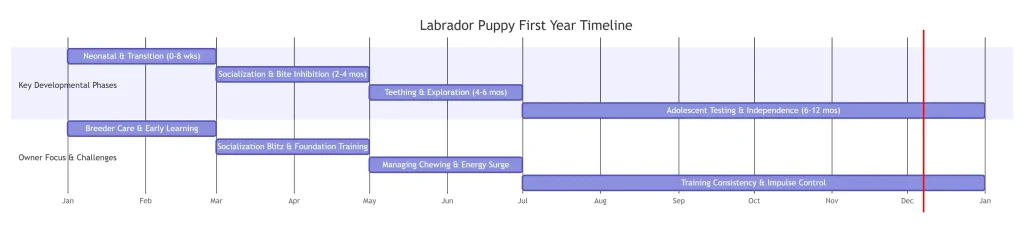
Phase 1: The Socialization Blitz (Months 2-4)
- Physical Milestones: Rapid growth, baby teeth are sharp, coordination improves.
- Behavioral Focus: This is the most critical window. Your priority is positive exposure to the world (people, sounds, surfaces, other vaccinated dogs/puppies). Focus on building confidence.
- Training Foundations: Begin house training, crate training, name recognition, “sit,” and bite inhibition. Keep sessions to 3-5 minutes.
- Owner Challenge: Managing the extreme mouthiness and constant supervision required. Exhaustion is normal.
Phase 2: The Teething Tornado (Months 4-6)
- Physical Milestones: Adult teeth come in, chewing drive peaks. They gain significant strength and size.
- Behavioral Focus: Chewing is a physical necessity. Redirect, redirect, redirect. Provide a plethora of frozen chew toys (soaked washcloths, Kongs).
- Training Focus: Solidify “leave it,” “drop it,” and begin leash walking skills. Introduce the “place” command to encourage calm.
- Owner Challenge: Protecting your home and possessions from destruction. Doubling down on patience and consistency.
Phase 3: The “Selective Hearing” Adolescent (Months 6-12)
- Physical Milestones: Growth slows but muscle fills in. Sexual maturity begins (if not spayed/neutered). They have near-adult stamina.
- Behavioral Focus: Testing boundaries. Previously reliable recalls may falter as independence and distraction increase.
- Training Focus: Proofing commands with higher distractions. Increasing exercise duration and intensity appropriately. Continuing to reinforce all training as if they’ve never learned it.
- Owner Challenge: The feeling that training has regressed. Don’t be discouraged. This is normal. Stay consistent, use higher-value rewards, and manage their environment to prevent rehearsal of bad habits.
The Spay/Neuter Discussion: A Perspective
The old rule of spaying/neutering at 6 months is being re-evaluated for large, active breeds like Labradors.
- Current Veterinary Guidance: There is growing evidence that allowing Labrador Retrievers to reach full skeletal maturity (often 12-18 months) before spay/neuter may reduce the risk of certain joint disorders (like cruciate ligament tears) and some cancers.
- Your Action Step: This is not a one-size-fits-all decision. Have a detailed conversation with your veterinarian about the latest research, your puppy’s individual health, and your lifestyle to determine the optimal timing. Responsible management is required if you choose to delay.
The Honest Challenges: What Lab Owners Wish They Knew
For every heartwarming video of a Lab gently carrying an egg, there is a real-life owner searching the internet at 2 a.m. for “how to stop my Labrador from eating the couch.” Their wonderful qualities come with a flip side that, if unprepared for, can lead to frustration and surrender. Here is the transparent, unfiltered reality of sharing your life with this magnificent, demanding breed.
The Shedding: It’s a Lifestyle, Not an Event
You will not own a black, yellow, or chocolate Lab. You will own a Labrador-colored home, car, and wardrobe.
- The Reality: Their double coat sheds lightly every day and “blows coat” heavily twice a year, covering your world in a fine layer of fur. It will be in your food, your bed, and your keyboard.
- The Management: The grooming tools from Section 3 are mandatory. Brushing 2-3 times per week with an undercoat rake is not optional. Invest in a robot vacuum and a powerful cordless stick vacuum. Accept fur as a condiment.
The “Hunger Games”: A Constant State of Vigilance
A Labrador’s appetite is not a joke; it’s a powerful, instinctual drive that governs their behavior.
- The Reality: They are masterful counter-surfers, trash divers, and food thieves. They will swallow items whole without chewing. This poses constant risks of poisoning, obstruction, and obesity.
- The Management: Never leave food unattended. Use child locks on lower cabinets and locking trash cans. Train a flawless “leave it.” Be vigilant on walks to prevent scavenging. Their diet must be strictly portion-controlled for life.
The Endurance: They Don’t “Calm Down” at Two
The promise that “they’ll calm down when they’re older” is misleading. A well-exercised adult Lab may have an “off switch” at home, but their capacity for and need for activity remains high for life.
- The Reality: This is not a dog that will be satisfied with a short walk around the block. Without adequate daily physical and mental exercise, they will develop anxiety, destructiveness, and nuisance behaviors like obsessive licking or barking.
- The Management: Commit to a minimum of one hour of vigorous activity daily, plus training or puzzle games. This is a 10-12 year commitment. They are partners for runners, hikers, and swimmers.
The Potential for Obesity: A National Epidemic
Over 60% of Labradors are overweight or obese. This is the leading cause of preventable health problems and can shorten their lifespan by up to two years.
- The Reality: Their genetics are working against them. Every extra pound stresses their joints, heart, and organs.
- The Management: Weigh their food. Limit treats. Maintain a lean body condition where you can easily feel their ribs. Have your vet assess their weight at every check-up. This is the single kindest thing you can do for their long-term health.
The Social Butterfly & Potential for Separation Anxiety
Their people-oriented nature means they crave constant companionship.
- The Reality: Labs are prone to separation distress if not taught from puppyhood that being alone is safe. This can manifest as destructive chewing, excessive barking, or attempting to escape.
- The Management: Implement alone-time training from day one. Use confinement (crate/pen) and provide a special long-lasting chew (frozen Kong) only when you leave. Never make a dramatic fuss over arrivals and departures.
Facing These Realities Head-On: Acknowledging these challenges isn’t negative; it’s responsible. It ensures that the joyful, loyal, and loving Labrador you envision is built on a foundation of realistic expectations and proactive management. The reward—a dog who greets you with unbridled enthusiasm every single day, who is your steadfast adventure buddy, and whose love is as deep as the ocean—is worth every bit of the effort.
Labrador Retriever Puppies FAQs
Here, Dr. Allona Jackson, DVM, answers the most pressing and common questions from prospective and new Labrador Retriever owners.
Are Labrador puppies hyper?
They are not inherently “hyper” in a neurotic sense, but they possess very high energy and drive. Without proper, structured outlets for their physical and mental energy, this can manifest as destructive, frenetic behavior that owners interpret as hyperactivity. A well-exercised and trained Lab is a focused, calm-in-the-home companion.
What’s the difference between English and American Labrador puppies?
This refers to breeding lines, not country of origin. English (or “Show”) Labs are often bred for conformation. They tend to be stockier, with a broader head, thicker otter tail, and a calmer demeanor. American (or “Field”) Labs are bred for hunting and field trials. They are typically leaner, more athletic, and have higher, seemingly endless energy and drive. Choose a line that matches your lifestyle: a show line for a slightly mellower family pet, a field line for an intense activity partner.
Are Labs easy to train for first-time owners?
Their intelligence and food motivation make them highly trainable, but their strength, energy, and stubborn streaks can be challenging for a novice. Success requires consistency, patience, and a commitment to providing sufficient exercise. Enrolling in a positive-reinforcement puppy class is highly recommended for first-time Lab owners.
How do I stop my Lab puppy from jumping up?
Jumping is a self-rewarding behavior (they get attention). The key is to make jumping unrewarding and sitting highly rewarding.
- As they jump, turn your body away, cross your arms, and be silent (no eye contact).
- The moment all four paws are on the floor, immediately turn back, say “Yes!” and reward with a treat or calm petting.
- Ask for a “sit” before giving any attention. Every single person who greets your dog must follow this protocol.
What are the most common health issues in Lab puppies to watch for?
While some issues appear later, the puppy-stage priorities are:
- Joint Development: Monitor for limping or reluctance to exercise, which could indicate hip/elbow dysplasia or panosteitis (“growing pains”).
- Obesity: The most common and preventable health issue. Start good habits early.
- Foreign Body Ingestion: Due to their indiscriminate eating. Watch for vomiting, loss of appetite, or lethargy.
- Ear Infections: Their floppy ears trap moisture. Regularly check for odor, redness, or discharge.
When will my Labrador puppy calm down?
You’ll notice a gradual decrease in chaotic puppy energy around 3-4 years old. However, their fundamental need for substantial daily exercise and engagement lasts their entire life. They don’t become couch potatoes; they become settled athletes who can relax after their needs are met.
Is a Labrador a good apartment dog?
It is challenging but possible with an exceptional commitment to exercise. A Lab can thrive in an apartment if provided with multiple long walks, trips to a dog park or field for running, and ample indoor mental stimulation. Without a yard to easily burn energy, the owner’s responsibility for structured activity increases significantly.
Conclusion & Next Steps
You’ve now walked through the complete roadmap—from the joyful chaos of a Labrador puppy’s personality to the proactive health strategies, essential gear, and foundational training needed to guide them. This journey is one of profound partnership. The early investment of time, patience, and consistent effort is the direct deposit you make into a lifetime of unwavering loyalty, goofy affection, and unforgettable adventures.
Your Labrador isn’t just a pet; they are a force of nature waiting to be channeled. By meeting their needs for structure, activity, and clear communication, you don’t just manage them—you unlock their full potential as the magnificent, loving companions they are bred to be.
Your Immediate Action Plan:
- Secure Your Veterinarian: If you haven’t already, schedule your puppy’s first wellness exam. Bring the questions from Section 2 about health testing, diet, and spay/neuter timing.
- Assemble Your Toolkit: Use the Lab-Proof Shopping List in Section 3 to get the durable essentials you need before your puppy comes home. Preparation prevents panic.
- Find Your Trainer: Research and enroll in a positive-reinforcement puppy class in your area. The socialization and professional guidance in those first months are invaluable.
- Embrace the Process: Remember the developmental timeline from Section 5. There will be trying phases. Refer back to this guide, stay consistent, and trust that the work is worth it.
Continue Your Family Dog Journey with AvailPet
This guide is part of our deeper commitment to educated, joyful pet ownership at AvailPet.com.
- 🔍 Compare Your Options: See how the Labrador’s traits stack up against other wonderful family breeds in our comprehensive pillar resource: Best Dog Breeds for Families.
- 📚 Deepen Your Knowledge: Stay tuned for our upcoming guides on “Advanced Training for High-Drive Dogs” and “Maintaining Your Labrador’s Health Through the Senior Years.”
- 🛒 Get Started Right: For your convenience, we’ve compiled our top, vet-approved picks into one list. Shop our curated Labrador Puppy Starter Kit here to confidently prepare for arrival day.
Thank you for entrusting us, and Dr. Allona Jackson, DVM, with this important chapter in your family’s story. Your dedication to starting with knowledge is the greatest gift you can give your new best friend.
Welcome to the incredible, active, and loving world of life with a Labrador Retriever.
Disclaimer: The information in this guide, including advice from Dr. Allona Jackson, DVM, is for educational and informational purposes only. It is not a substitute for professional veterinary medical advice, diagnosis, or treatment. Always seek the advice of your own veterinarian. As an Amazon Associate, we earn from qualifying purchases. We may earn a commission from links on this page, at no extra cost to you.
Sources:
- American Veterinary Medical Association (AVMA)
- Orthopedic Foundation for Animals (OFA)
- American Kennel Club (AKC) Canine Health Foundation
- Labrador Retriever Club’s health guidelines