Vet Reviewed By: Dr. Allona Jackson, DVM
Dr. Jackson is a practicing veterinarian with over 10 years of experience in small animal care. She reviews all content on AvailPet.com for medical accuracy and pet safety.
Your 90-pound German Shepherd just bolted after a squirrel — again. Your voice doesn’t matter. The leash is useless. You’re left standing there, frustrated, while your dog disappears into the trees.
Large, stubborn breeds present unique training challenges. They’re strong enough to pull you off your feet. Their prey drive can override any verbal command. And when they decide to run, you simply cannot outrun them.
That’s where a modern electronic collar (e-collar) comes in — not as a punishment device, but as a long-distance communication tool.
I’m Dr. Allona Jackson, DVM. In this guide, I’ll walk you through the 5 best shock collar for large dogs in 2026, how to use them safely, and exactly when you should not use one at all.
Disclosure: This article contains affiliate links. If you purchase through these links, AvailPet.com earns a small commission at no extra cost to you.
The 5 Best Shock Collars for Large Dogs at a Glance
*Short on time? Here are my top 5 vet-reviewed picks for large dogs (50-120+ lbs). Each collar has been evaluated for range, stimulation levels, durability, and safety features.*
| Product | Best For | Range | Stimulation Levels | Battery Life | Price Range |
|---|---|---|---|---|---|
| Bousnic Dog Shock Collar | Overall best value | 3,300 ft | 16 | 30 days standby | 50−70 |
| PetSpy Dog Training Collar | Longest battery | 1,950 ft | 16 | 40 days standby | 40−60 |
| Jugbow Dog Shock Collar | Best budget | 1,000 ft | 8 | 15 days standby | 30−45 |
| Nikketta Shock Collar for Dogs | Best for extra-large breeds (28″ neck) | 1,600 ft | 8 | 10 days standby | 35−50 |
| Bousnic 2-Dog System | Best for multi-dog households | 3,300 ft | 16 | 30 days standby | 70−90 |
Do Large Dogs Really Need a Shock Collar? (Vet’s Perspective)
Let me be clear from the start: Most dogs do not need an e-collar. Positive reinforcement training works beautifully for the average family pet.
But large, stubborn breeds are not average family pets in every home.
Here’s why large dogs present unique training challenges:
- Sheer strength: A 100-pound Rottweiler can pull a 160-pound adult off their feet. Verbal corrections don’t stop momentum.
- Prey drive: Breeds like Huskies and German Shepherds were bred to chase. When that instinct kicks in, your voice disappears from their awareness.
- Independence: Many large working breeds were bred to make decisions without human input. Getting them to want to listen to you requires more than treats.
Breeds that often benefit from e-collar training (when used correctly):
- German Shepherd
- Rottweiler
- Siberian Husky
- Labrador Retriever (field lines)
- Doberman Pinscher
- Great Dane
- Mastiff breeds
“A shock collar isn’t a replacement for training — it’s a long-distance communication tool for proofing commands your dog already knows.” — Dr. Allona Jackson, DVM
Important disclaimer: An e-collar is appropriate only after your dog understands basic commands (sit, stay, come) with positive reinforcement. It is never for puppies under 6 months. And it is never for punishment.
If you’re still working on basic obedience, start with our pillar guide to best dog collars first →
How to Choose a Shock Collar for a Large Dog (Buying Guide)
Not all e-collars are created equal. Here are the five features that matter most for large breeds.
Range: How Far Will Your Dog Roam?
Large dogs cover ground fast. A 500-foot collar is useless for off-leash hiking — your dog can cross that distance in 3 seconds.
My recommendation: Minimum 1,000 feet. Ideal is 2,000+ feet.
- Bousnic leads with 3,300 feet (best for hiking, rural properties)
- PetSpy offers 1,950 feet (good for most suburban parks)
- Jugbow has 1,000 feet (fine for backyard training only)
Stimulation Levels: More Is Better
You need very low levels for sensitive moments and high levels for high-arousal situations (like chasing a deer). More levels give you finer control.
My recommendation: At least 8 levels. Ideally 16.
- Bousnic & PetSpy offer 16 levels (best for fine-tuning)
- Jugbow & Nikketta offer 8 levels (adequate for most owners)
Waterproof Rating (IPX7 vs. IPX8)
Large active dogs get wet — rain, puddles, lakes, drool.
- IPX7 = Submerged up to 3 feet for 30 minutes (sufficient for rain, mud, washing)
- IPX8 = Submerged beyond 3 feet (for serious swimming retrievers)
My recommendation: At least IPX7 for all large dogs.
All five collars in this guide are IPX7 waterproof.
Battery Life
Large dogs may wear e-collars for longer training sessions. And let’s be honest — you will forget to charge it.
My recommendation: Minimum 10-15 days standby. PetSpy’s 40-day standby is exceptional.
Collar Fit for Large Necks
This is the most overlooked feature. Many “large” collars max out at 22 inches — which is too small for a full-grown Labrador.
Measure before buying: Wrap a soft tape measure around the middle of your dog’s neck (not the throat). Add 2 inches for comfort.
| Breed | Typical Neck Size |
|---|---|
| Labrador, German Shepherd | 18″ – 22″ |
| Rottweiler | 20″ – 24″ |
| Great Dane, Mastiff | 24″ – 28″ |
Nikketta fits necks up to 28 inches — your only option for truly giant breeds.
For a complete guide on measuring, see our dog collar sizing guide →
5 Best Shock Collars for Large Dogs – Full Reviews
1. Bousnic Dog Shock Collar – Best Overall for Large Dogs
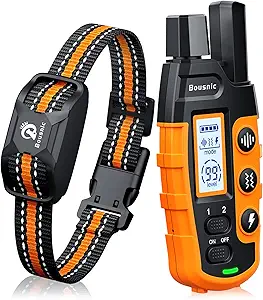
Why it’s #1: The Bousnic hits the sweet spot of long range (3,300 feet), plenty of levels (16), and reasonable price ($50-70). For most large dog owners, this is the one.
Best for: Active large breeds (Labs, Shepherds, Huskies) who need long-range recall for hiking, beach trips, or rural properties.
Pros:
- 3,300 ft range — best in its price class
- 16 stimulation levels + vibration + beep
- IPX7 waterproof
- Fast 2-hour charging
Cons:
- Remote feels slightly cheap/plasticky
- Instruction manual is poorly translated
- Only one dog per remote (upgrade to 2-dog version for multi-dog homes)
Dr. Jackson’s take: *”The 16 levels give you fine-grained control. Most owners find level 4-6 works for basic recall on a Labrador — that’s exactly what you want. You don’t need high levels if the collar is fitted correctly.”*
🔗 Read our full in-depth review: Bousnic Dog Shock Collar Review →
2. PetSpy Dog Training Collar – Best Battery Life
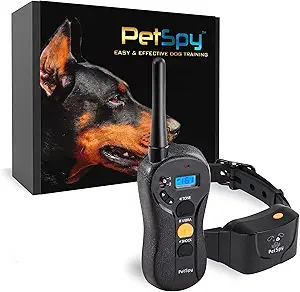
Why it’s #2: 40-day standby battery is extraordinary. If you’re the type who forgets to charge devices, this collar will save you.
Best for: Owners who take long camping trips, forgetful chargers, or anyone who wants to charge once a month.
Pros:
- 40-day standby battery (unmatched in this price range)
- 16 stimulation levels
- Clear, loud beep tone
- Durable remote with belt clip
Cons:
- Range is 1,950 ft (good, but shorter than Bousnic)
- Bulkier receiver on the dog’s neck
- Slightly more expensive than Jugbow
Dr. Jackson’s take: “For weekend warriors who charge once a month, this is your collar. I just wish the range matched Bousnic. But if you’re training in a suburban park or fenced property, 1,950 feet is plenty.”
🔗 Read our full in-depth review: PetSpy Dog Training Collar Review →
3. Jugbow Dog Shock Collar – Best Budget Option
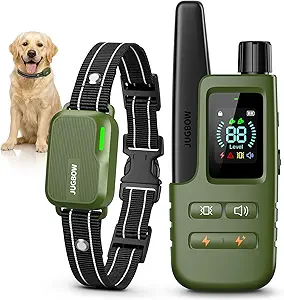
Why it’s #3: Under $45, you get a functional e-collar that works for basic training. Perfect for first-time users who aren’t sure if an e-collar is right for their dog.
Best for: First-time e-collar users, owners on a tight budget, or training in a fenced backyard only.
Pros:
- Very affordable ($30-45)
- Simple, intuitive remote (great for beginners)
- 8 levels + vibration + beep
- IPX7 waterproof
Cons:
- Only 8 stimulation levels (not as precise as Bousnic/PetSpy)
- Shorter range (1,000 ft)
- Battery lasts only 15 days
Dr. Jackson’s take: *”For a backyard or small fenced property, 1,000 feet is plenty. Just don’t expect to use this for serious off-leash hiking. But for $35? It’s a perfectly fine starter collar.”*
🔗 Read our full in-depth review: Jugbow Dog Shock Collar Review →
4. Nikketta Shock Collar for Dogs – Best for Extra-Large Breeds
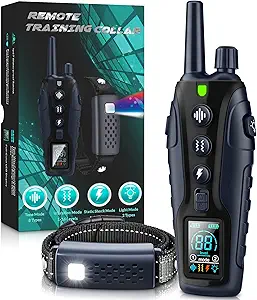
Why it’s #4: Most collars max out at 24-25 inches. Nikketta fits necks up to 28 inches — essential for Great Danes, Mastiffs, and Saint Bernards.
Best for: Truly giant breeds that don’t fit standard collars.
Pros:
- Extra-long strap fits necks up to 28″
- Simple 8-level design (easy for beginners)
- Affordable ($35-50)
- IPX7 waterproof
Cons:
- Shorter range (1,600 ft)
- Only 8 levels
- Basic features (no advanced programming)
Dr. Jackson’s take: *”If you own a 180-pound Mastiff, most collars won’t fit. Full stop. Nikketta solves that problem. The range is fine for most properties — your Mastiff isn’t running a mile away anyway.”*
🔗 Read our full in-depth review: Nikketta Shock Collar for Dogs Review →
5. Bousnic Dog Shock Collar for 2 Dogs – Best Multi-Dog System
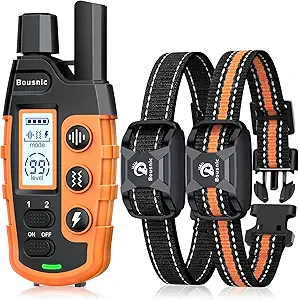
Why it’s #5: Control two dogs from one remote. This is significantly cheaper than buying two separate single-dog systems.
Best for: Owners with two large dogs (or one large + one medium) who roam together.
Pros:
- Same great features as single-dog Bousnic: 3,300 ft range, 16 levels, IPX7
- Dual-channel remote (left button = Dog 1, right button = Dog 2)
- Can train both dogs individually or together
Cons:
- More expensive than single-dog version ($70-90)
- Only controls two dogs (not three+)
Dr. Jackson’s take: *”If you have two Shepherds who roam together, this is cheaper than buying two separate systems. The remote is intuitive — left button for Dog 1, right for Dog 2. I just wish they made a 3-dog version.”*
🔗 Read our full in-depth review: Bousnic 2-Dog Shock Collar System Review →
Comparison Table – All 5 Collars Side by Side
| Feature | Bousnic | PetSpy | Jugbow | Nikketta | Bousnic (2-Dog) |
|---|---|---|---|---|---|
| Range | 3,300 ft | 1,950 ft | 1,000 ft | 1,600 ft | 3,300 ft |
| Stimulation Levels | 16 | 16 | 8 | 8 | 16 |
| Battery Standby | 30 days | 40 days | 15 days | 10 days | 30 days |
| Waterproof | IPX7 | IPX7 | IPX7 | IPX7 | IPX7 |
| Max Neck Size | 25″ | 24″ | 24″ | 28″ | 25″ |
| Multi-Dog | No | No | No | No | Yes (2 dogs) |
| Price Range | $$ | $$ | $ | $ | $$$ |
| Best For | Overall | Battery life | Budget | XL breeds | Multi-dog |
How to Safely Train a Large Dog with a Shock Collar (Step-by-Step)
This is the most important section of this guide. An e-collar used incorrectly is not just ineffective — it’s harmful. Follow these steps exactly.
Step 1: Find the Right Fit
The collar must sit high on the neck, just below the ears — not low near the shoulders.
- You should be able to fit two fingers between the collar and your dog’s neck
- The two contact points must touch skin (trim thick fur if needed)
- If the collar slides or spins, it’s too loose
For detailed fitting instructions, see our proper collar fit guide →
Step 2: Find the Lowest Effective Level
Your dog should never yelp, flinch hard, or show fear. If they do, the level is too high.
- Start at level 1 on the remote
- Press the stimulation button while your dog is relaxed (not mid-chase)
- Watch for a subtle response: ear twitch, head turn, neck muscle tensing
- If no response, increase by 1 level every 30 seconds
- Stop at the first level that gets a subtle response
For most large dogs, that working level is 4-8 on a 16-level collar.
“If level 2 on your own wrist feels unpleasant, start there. Your dog’s neck is more sensitive than your wrist. Train with empathy, not anger.” — Dr. Allona Jackson, DVM
Step 3: Pair Stimulation with Known Commands
Never “shock first, ask later.” Your dog must already know the command.
The sequence:
- Give a known command: “Come!”
- Wait 1 second
- If your dog doesn’t respond, tap the stimulation button (at working level)
- As your dog moves toward you, release the stimulation button
- Reward with praise or treat when they arrive
Over time, your dog learns that following the command turns off the stimulation.
Step 4: Use Vibration/Beep as a Warning
Most collars have a non-stimulation mode (beep or vibrate). Use this as a “pre-cue.”
The warning sequence:
- Beep or vibrate once
- Wait 2 seconds
- If your dog doesn’t respond, follow with stimulation
Many dogs learn to respond to the beep alone within 1-2 weeks.
Step 5: Never Use for Punishment or Anger
This is non-negotiable.
Never use an e-collar for:
- Potty accidents in the house
- Chewing furniture
- Growling or aggression toward people (see a veterinary behaviorist instead)
- Any behavior you haven’t trained with positive reinforcement first
Dr. Jackson’s safety rules:
- Remove collar after 12 hours (rotate location daily to prevent pressure sores)
- No collar on crated dogs (even e-collars can snag — see our [collar safety guide →] [insert internal link: /dog-collar-safety-guide])
- No use on puppies under 6 months
- No use on dogs with heart conditions or seizure disorders without veterinary approval
What Size Shock Collar Does My Large Dog Need?
How to measure: Wrap a soft tape measure around the middle of your dog’s neck (not the throat). Pull snug but not tight. Add 2 inches.
Size chart by breed:
| Breed | Neck Circumference | Recommended Collar Strap Length |
|---|---|---|
| Labrador Retriever | 18″ – 22″ | 24″ – 26″ |
| German Shepherd | 18″ – 24″ | 24″ – 28″ |
| Rottweiler | 20″ – 24″ | 26″ – 28″ |
| Siberian Husky | 18″ – 22″ | 24″ – 26″ |
| Doberman Pinscher | 16″ – 20″ | 22″ – 24″ |
| Great Dane | 24″ – 28″ | 28″ – 32″ |
| Mastiff | 24″ – 28″ | 28″ – 32″ |
Pro tip: If your dog has a thick double coat (Husky, German Shepherd), measure with the coat as-is. Do not compress the fur.
For more detail, read our complete dog collar size guide →
FAQs About Best Shock Collar for Large Dogs
Are shock collars cruel?
No, when used correctly. Modern e-collars use low-level stimulation, not painful shocks. Cruelty comes from misuse — high levels, punishment for confusion, or training with anger. Used as described in this guide, they are safe and effective.
What’s the best shock collar for a stubborn German Shepherd?
Bousnic (3,300 ft range, 16 levels) or PetSpy (40-day battery). Both offer the precision you need for a smart, stubborn breed. See Bousnic on Amazon →
Can I use a shock collar on my 6-month-old puppy?
No. Wait until 6 months minimum. Puppies under 6 months lack impulse control and may associate the stimulation with you (not the behavior), creating fear. Start with puppy training collars →
How long can I leave a shock collar on?
Maximum 12 hours. Remove overnight and rotate the collar’s position daily to prevent pressure sores. Never leave an e-collar on a crated dog.
Will a shock collar stop my dog from running away?
When trained properly — yes. The collar reinforces recall commands at a distance. But the collar alone does nothing. Training (following the 5 steps above) solves running away.
What level should I use on my large dog?
Start at level 1 and work up until you see a subtle ear twitch or head turn. For most large dogs, that’s level 4-8 on a 16-level collar. If your dog yelps or cowers, the level is too high.
Are shock collars waterproof?
Most are IPX7 (rain, puddles, shallow water). All five collars in this guide are IPX7. Check product specs before swimming — some are not fully submersible.
My dog yelps at level 2 — is something wrong?
Yes. Either: (1) the collar is too tight (contact points pressing too hard), (2) your dog is unusually sensitive, or (3) the collar is defective. Loosen the collar first. If yelping continues, return to vibration-only mode or consult your veterinarian.
⚠️ Vet Warning: Do NOT Use a Shock Collar If Your Dog Has:
- Aggression toward people or other dogs — e-collars can make aggression worse. See a veterinary behaviorist instead.
- Heart conditions or seizure disorders — electrical stimulation may trigger episodes. Consult your cardiologist or neurologist before using any e-collar.
- Anxiety or fear-based behaviors — e-collars increase fear and anxiety. Use positive reinforcement training only.
- Skin conditions or allergies — contact points will worsen irritation. Heal the skin first.
When in doubt, schedule a training consult with a certified professional who uses modern e-collar methods.
Conclusion – Which Shock Collar Should You Buy?
There’s no single “best” shock collar for every large dog. The right choice depends on your dog’s size, your training environment, and your budget.
Here’s my quick recommendation guide:
| If you have… | Buy this… |
|---|---|
| An active large dog who roams far (hiking, rural property) | Bousnic – 3,300 ft range, 16 levels |
| A busy owner who forgets to charge devices | PetSpy – 40-day battery life |
| A tight budget (under $45) | Jugbow – Solid starter collar |
| A Great Dane or Mastiff (neck over 25″) | Nikketta – Fits up to 28″ |
| Two large dogs | Bousnic 2-Dog System – Best value for multi-dog |
“Buy the collar with the lowest level you can feel on your own hand. Test it. If level 2 on your wrist feels unpleasant, start there. Your dog’s neck is more sensitive than your wrist. Train with empathy, not anger.” — Dr. Allona Jackson, DVM
Ready to learn more?
Explore our complete dog collar ecosystem:
- Pillar guide: Best Dog Collar (2026): The Ultimate Buying Guide for Every Dog →
- Related articles:
- Best Bark Collar for Small Dogs →
- Best Training Collar for Puppies →
- Best Leather Dog Collar →
- Best Nylon Dog Collar →
- Best Reflective Dog Collar →
- Best Personalized Dog Collar →
Safety & educational guides:
- Dog Collar Safety Guide →
- How to Measure Dog Collar Size →
- How to Properly Fit a Dog Collar →
Disclaimer
The information provided in this article is for general informational and educational purposes only and does not constitute professional veterinary advice, diagnosis, or treatment. Always seek the advice of your veterinarian or a qualified veterinary behaviorist with any questions you may have regarding your pet’s medical condition or training needs. Never disregard professional veterinary advice because of something you have read in this article. Product recommendations are based on independent research and affiliate partnerships. AvailPet.com and Dr. Allona Jackson, DVM are not responsible for any injury, loss, or damage resulting from the use or misuse of any product mentioned in this guide.
Sources
- American Veterinary Medical Association (AVMA). “Electronic Collar Use in Dogs.”
- American College of Veterinary Behaviorists (ACVB). “Finding a Veterinary Behaviorist.”
- American Kennel Club (AKC). “Electronic Collar Training: What Every Owner Should Know.”
This guide was reviewed for medical accuracy by Dr. Allona Jackson, DVM. Last updated: May 2026.